My historical novels Rebel Puritan and The Reputed Wife, Herodias (Long) Hicks Gardner Porter, colonial New England, travels, and whatever else seizes my fancy...
Showing posts with label Mary Barrett Dyer. Show all posts

Monday, November 4, 2013

Mary Dyer Illuminated


My guest today is Christy K. Robinson, author of the 2013 historical novel, Mary Dyer Illuminated, its forthcoming sequel Mary Dyer: For Such a Time as This, and the non-fiction The Dyers of London, Boston, and Newport.

I hold a great deal of enthusiasm for both Christy and her books about Mary Dyer, not only because they encompass the life and times of Herodias Long, but also because Mary Dyer Illuminated is a superb read, and Christy is a superb friend. And now, without further ado, here’s Christy!

Thank you, Jo Ann, for hosting this interview on your website. Your readers should know that through our research into Herodias Long and Mary Dyer, Jo Ann and I became acquainted in Facebook, and then close friends who shared research, after which personal details bonded us together. When Jo Ann took a road trip, we got to spend some hours together in my home. We’re even cousins, going back to late-17th century New Englanders.

JB: Your history is impeccable. When did you begin research for your book?
CR: I did a lot of genealogy research on my family lines when I was a teenager, driving my mom to the LDS genealogical library about 30 miles across the city. These were printed books and microfilms, long before the Internet came to town! She discovered that she and I were direct descendants of Mary Barrett Dyer, whom I’d never heard of. 

We both believed the stuff you read now on the Wiki and genealogy pages, which were copied from the Quaker historians: that Mary Dyer was hanged (the word is hanged, not hung) “for the crime of being a Quaker.” But as you’ll see in my research blog, two novels, nonfiction book, Facebook pages, etc., that is NOT the case. It wasn’t a crime to “be” a Quaker, and no one died for it. Mary and three men deliberately chose to die in civil disobedience, though they had several clear opportunities to just leave Massachusetts Bay Colony.

Mary Dyer's statue
I was commissioned to write and photograph a women-in-ministry convention in New England during leaf-peeping time in October 1997.  As we traveled by coach, a history professor lectured on the Quaker women who were persecuted in the area, and that Hutchinson and Dyer had memorial statues “on Boston Common.” (Actually, they face the Common.) When I learned I’d be stuck at Logan Airport for hours before my plane would board, I jumped into a taxi for a ride to the Common for a personal quest. I was not wearing proper shoes for city walking, cobblestones, or the half-run I made through the park, peering at every monument. Finally, I found Mary, and took several photos before taking another taxi back to the airport. I went home, consulted my files, and counted up the “greats” behind “grandmother”: nine greats. Twelve generations.

The philosophical and theological bits have been a lifelong interest, and while doing some hobby genealogy study on Mary Dyer in about 2006, I ran up against terms I didn’t understand. So I started reading about Anne Hutchinson and antinomian beliefs, and then early Quaker beliefs. It was a revelation to learn that my own church was rooted deeply in New England’s Puritan ways (not in doctrines, necessarily, but in the “corporate culture” of the believers). In 2010, I decided to write a novel about both Mary and William Dyer, and the research began with scores of books and hundreds of internet searches.

JB: How much is known of William Dyer and Mary Barrett’s early lives? Do you know where they were born?
CR: Very little is known of their early lives. There’s a christening record for William in September 1609 that lists his father’s name, but not his mother’s. Mary was born about 1610-11, probably in or near London. There are snippets of rumors that say she was in attendance at the court of Charles I, but no proof. The first real record of Mary is her wedding to William on September 27, 1633, at St. Martin-in-the-Fields church. 

JB: You write about Mary Dyer’s life as if you know her. How much is actually known of Mary’s early life?
CR: I think I do know her! But not because of any family stories, legends, or mystical experiences. As I explained above, what little I knew was wrong. But I so thoroughly researched her culture, religious beliefs, friends and enemies, surroundings, what took place later in her life, etc., that I could place her in situations and then project what probably happened based on what the people around her did and said.

As for what is actually known about Mary, I learned that many of the things I thought were established fact, were written by Quaker historians who had an agenda, which was not to write factual details or investigative journalism. Their agenda was to promote their beliefs and persuade others to support or at least tolerate their practices. In essence, they were public relations and communications managers for their new sect. I recognized that because it’s what I did for years, for two universities and a nonprofit organization!

JB: John and Margaret Dyer were real people. Why did you choose them for Mary’s guardians?
CR: I saw John’s name in a tax record on Johan Winsser’s trustworthy research website. John’s poor-roll tax was substantial, so they had some money. Then I went hunting for, and found, his childless wife that he married rather late in life. They lived in the right place and had a name that would fit my novel plotting.

1625 London plague woodcut
I also decided that with major plague epidemics regularly raging in London, and killing tens of thousands of residents at a time, Mary Barrett and William Dyer and his master must have had an escape hatch. And since Mary would be a mistress of garden and farm servants in just a few years, she would have to learn practical economics. So I needed people who lived out in the country but had ties in the city. I created the Stansbys, in the real village of Willesden.

JB: I remember being told in school that the Puritans came here for religious freedom. You write that they hid their religious intent behind stated plans to make investors rich.
CR: Yes, they were a corporation designed to make money in development and export of New England’s natural resources of timber, shipbuilding, furs, food production, fishing, and other commercial pursuits, plus all the support industries to make a viable, flourishing community. Really, who could blame them, when they had to sell their homes, farms, animals, and businesses in England that were being heavily taxed? They were imprisoned by the king’s men for their dissent and refusal to conform to religion or government. Some of them had to flee their homeland in secrecy to avoid imprisonment. So often, incarceration itself caused death.

Of course, religious freedom meant that they were free from Anglican rule, but they held themselves to a far more strict code. In London, John Winthrop worked as a magistrate in wills and estate trusts, but his refusal to take the usual bribes and deal dishonorably as his colleagues did made him stand out, and he had to resign and try to melt into his Essex manor until the fleet could depart from England. They seemed very moderate when they were in England, but when they got to Massachusetts, they were religious extremists. John Endecott, in particular, was a proto-Taliban! They truly intended to build a New Jerusalem that would hasten the second coming of Christ.

You might be surprised to learn that I wrote John Winthrop, a man who became a principal enemy of Hutchinson and Dyer, as a sympathetic character in his private life.  But I could never get into Endecott’s head or find a sympathetic trait. I had other characters describe him.

JB: The Puritans took the royal charter for Massachusetts with them. What does that signify?
CR: The charter should have been kept in London with every other official document. With the king’s seal on it, they acted as if in his name and authority. But they always intended to form their own theocratic government with minimal oversight from the king they considered pro-Catholic and politically repressive. King Charles demanded the return of the charter numerous times, but Winthrop ignored the orders. When an envoy tried to come over and take it back, his ship seemed to disintegrate under him like some X-Files scene. Winthrop gloried in that, saying that God had miraculously protected them.

JB:  We think of Puritans all dressed in black and white. However, your women wear rainbow colors.
CR: Black clothes were only for the very rich because they were expensive to dye and maintain without fading in the sun or the washing.  The few portraits from New England at that time were done of the elite members of society who were wearing their best duds at the sittings: black. I read lots of blogs on fashions, including Plimoth Plantation’s, and studied paintings of the 17th century, to see what men and women wore. Guess what: not that many ball gowns! I also chased down what Englishwomen wore to their weddings, and they were not wearing white until Queen Victoria, two centuries later.

"Blood Moon"
JB:  Was there really a lunar eclipse on the night of Anne Hutchinson’s miscarriage? New Englanders’ hair must have been standing on end at the sight of the blood moon.
CR: There really was a blood-red lunar eclipse on June 25, 1638, and it was observed on Aquidneck Island—by our people! The blood moon was, to them, a sign of the Apocalypse. But no one knows the date of Anne’s miscarriage. I timed out the reports of it in July, and I knew how long a molar pregnancy can last (about 12 weeks), and that there was no report of it on June 1, when the huge earthquake hit, so for dramatic purposes and Anne’s labor, I chose the lunar eclipse near the end of June—which would be 12 weeks after Anne was released from house arrest and had a celebratory conjugal reunion with her husband!

Christy K. Robinson
That’s one of the things that distinguishes my books from what’s come before and has been so heavily reliant on the Quaker writers. I used real events, internet research into science and medicine and astronomy, and a timeline!  The timeline opened my eyes to all kinds of surprises, and blew me away many times, as Jo Ann and my sister-in-law can attest. You’ll have to see the “signs and wonders” that begin in Mary Dyer Illuminated and come with even more importance in the second volume, Mary Dyer: For Such a Time as This (to be released in December 2013).  There’s also a Kindle-only companion book to the two novels, full of research into the culture and fascinating factoids I’ve found. That one is called The Dyers of London, Boston, & Newport.  

Sunday, July 21, 2013

Rhode Island's famous Hoydens and Firebrands

Anne Hutchinson's statue at Boston's State House
Hoydens and Firebrands is a superb blog devoted to "Roaring Ladies who write about the 17th Century." That would be me, and this week Hoydens and Firebrands are hosting me in a tale about Anne Hutchinson, Mary Dyer, and of course, Herodias Long. All three are noted 17th century Rhode Island firebrands, but Herodias is also notorious for her hoyden-esque life too! Please click on over to my post, and huzzah for Roaring Ladies!
 
http://hoydensandfirebrands.blogspot.com/2013/07/guest-post-jo-ann-butler.html

Wednesday, June 19, 2013

The Hanging of Mary Dyer

Mary Dyer on her way to the gallows
On May 31, 2013, Christy English hosted me on her blog for this post commemorating the martyrdom of Mary Dyer on June 1, 1660. http://www.christyenglish.com/2013/05/31/the-hanging-of-mary-dyer-by-joann-butler/

Here is my post:

June 1 is a sad anniversary in New England history. On that day in 1660 Mary Dyer was hanged in Boston for defying the Puritan government’s order of banishment on pain of death. What events led to the execution of that highly respected woman, and what does Mary Dyer have to do with my favorite Rhode Island obsession, Herodias Long?
 

Some quick background on what the Puritans were thinking when they hanged Mary. Decades earlier they had watched political, financial, and religious harassment by King Charles I and the Church of England escalate. Then the Pilgrims, a Puritan sect who had fled first to Holland, settled at Plymouth, Massachusetts in 1620.
Winthrop, John_-Wikipedia(5)
Governor John Winthrop

Backed by the Massachusetts Bay Company, Governor John Winthrop led over 700 men, women, and children in search of a place where they could worship freely. They settled on a peninsula in Massachusetts Bay in 1630. The Puritans’ stated purpose was to be a “city upon a hill.” The world would marvel as a Godly community prospered and the Wampanoag Indians flocked to convert to Christianity. The Puritans would also trade for furs with said Wampanoags, scout for gold and minerals, and repay their backers. 

The Puritans briefly lost the governor’s seat to Sir Henry Vane in 1637. Their response was to purge their community of a liberal, perhaps heretical faction of voters.
Vane, Henry-Wikimedia
Sir Henry Vane

The men who voted Harry Vane into power sought a more liberal flavor in their Puritanism. Anne Hutchinson held meetings in her home to critique Puritan sermons. Soon 80 people were crowding to hear her, and even more were noted to be discontent. Anne was banished as a heretic, but not before 142 men were ordered to turn in their arms, and then to recant or to leave. 84 men took their families and departed, most of them to Rhode Island in winter-spring, 1638. 
William and Mary Dyer and their young son were among the families who began farming on the north end of Rhode Island (then called Aquidneck). A year later, discontent over leadership led the Dyers to follow William Coddington southward to establish Newport.
Hutchinson, Anne trial 1
The trial of Anne Hutchinson
Herodias Long, then Hicks, her husband, and their children arrived in Newport in the same year. John Hicks was not accused of supporting Anne Hutchinson, yet perhaps the Hickses were sympathetic enough to leave Puritan Massachusetts for Newport in summer, 1639.

With Anne and her malcontents gone, the Puritans continued to purge their colony of undesirables. Criminals and suspected heretics were banished. Catholics and free-thinkers like Roger Williams were told to leave. Baptists were jailed and flogged. Quakers began to arrive in Boston in 1656. The first two women were stripped and searched for witches’ marks, then jailed. Then more Quakers arrived. Mary Dyer, who had become a Quaker in England, was jailed in Boston for over two months as the Puritans wrote even harsher laws. Soon Quaker missionaries were being severely flogged.
The Puritans were defensive about their laws. Aren’t they the same as locks on a man’s door to keep intruders out? Besides, the Quakers had plenty of warning, and were guilty of their own deaths. Their ministers concurred, saying that the Quakers were under Satan’s influence, and little more than witches.
You are thinking, “What has this got to do with Herodias Long?” Well, Mary Dyer brought her Quaker faith to Newport in June, 1657. Quaker literature tells us that in May, 1658 ‘Horred’ Gardner shouldered her nursing infant. With a girl to assist her, they walked 50 through the wilderness to Weymouth, Massachusetts to protest Puritan cruelties done to Quakers.
Punishment 1670
Whipping a Quaker 'out of town'
Herod and her maid were arrested, marched to Boston, where they were both stripped to the waist in public, and then whipped. Herod sheltered her baby in her arms, and afterward prayed that God would forgive the Puritans.
It seems that Herodias Long and Mary Dyer must have been close friends. After all, Herod walked 60 miles to defend the Quakers a year after Mary brought that faith to Newport. I can’t prove from contemporary writings that the two were friends, but the two young mothers brought their families to the very small, very new town of Newport at the same time. They attended the same church, and their husbands served in the same government. Of course Herod and Mary knew each other, and well.
Herod’s conversion to Quakerism, if it happened at all, was brief. She never appears in Quaker writings after her whipping, as other Quaker martyrs did. Her name is not seen in the records of Quaker meetings which became established near Herod’s homes. I believe that Herod was a woman of conscience who spoke out against Puritan abuse, but I don’t believe she was a Quaker.
quaker execution
Quakers walking to the gallows
What of Mary? She was jailed several times in Boston, but was not whipped, probably because she once lived in Boston, and perhaps because she was a woman of some means. Rumors abound that Mary was of noble birth, but no researcher has turned up her roots.
In 1659 Mary was led to the gallows. She watched two male Quakers hang, and then stepped willingly onto the ladder herself. The executioner snugged the noose around her neck and hooded her face, but then she was reprieved and sent back to Rhode Island. Once more the court’s sentence was ‘banishment on pain of death’ should she return to Boston.

Mary Dyer did exactly that in May, 1660. She never preached a word against Puritan ministers or government, as other Quakers did. She disturbed no meetings, nor the peace of the marketplace. Mary came to Boston to visit jailed Quakers, and to defy that order of banishment. If the Puritans hanged her – and they did – maybe witnesses would speak out too, and eventually those bloody laws would be rescinded.
King Charles II of England
In 1661 King Charles II was horrified when he read of Mary’s death, and ordered the hangings to end. Charles also read of Herod’s flogging. The friends’ sacrifices of blood and life were not in vain, for they helped to stir a monarch’s heart, and to end the killing.
RW
What did Herod do when she heard that her friend faced the Puritans’ gallows? The record is mute, but I drew on the friendship and sacrifices of Mary Dyer and Herodias Long for my historical novel The Reputed Wife. I hope you’re curious enough to find out what happened next …

Thursday, September 13, 2012

Why Mary Barrett Dyer?


Christy K. Robinson
My guest today is Christy K. Robinson, who is hard at work writing a novel about Mary Dyer.  Mistress Dyer is a well-known resident of Newport, Rhode Island, and is featured in my "Rebel Puritan."  I asked Christy what attracted her to Mary, and she can tell you in her own words:
 
Why Mary Barrett Dyer?

By Christy K Robinson

Historical fiction has been my favorite literary genre since I was a young girl. I’ve learned that several of my author friends read my favorite book series on the Childhoods of Famous Americans when we were kids, and it shaped our discovery of history and historical fiction by humanizing icons of history and making them accessible to children. It tickled our imaginations to learn about culture and what life might have been like for Virginia Dare, Martha Washington, or Abigail Adams, as children. (There were boys in the series, too, of course.)

Mary Dyer and Christy Robinson
My mother was chronically ill, and she drafted me to help her at genealogy and history archives with the fetch-and-carry jobs, or searching the reference files (you know, the little card drawers at the book place, that preceded the search engine). We traced many of our lines back through renaissance and medieval eras to European royalty. One of our most important discoveries in the 1970s was the confirmation that we were 11 and 12 generations descended from Mary Barrett Dyer, the 17th-century Quaker martyr. In the 1970s and 80s, we believed that Mary was hanged by those mean Boston Puritans for her religious beliefs, “simply for being a Quaker.” Unfortunately, that belief persists in countless web pages today.

Mary Dyer had several opportunities to avoid prison and execution. She could have lived her life in peace and safety, doing anything she wanted to, in Rhode Island, the colony she co-founded. But she intentionally returned to Boston several times to defy her banishment-on-pain-of-death sentence, until she forced their hand and they executed her. It’s not that she wanted to die, but that she was willing to die to shock the citizens into stopping their leaders from the vicious persecution of Quakers and Baptists. Whippings such as Herodias Gardner’s. Mary and other Quakers believed they were called by God to “try the bloody law,” the law that required torture, bankrupting fines, exile, and death for dissenters.

1662 Rhode Island charter
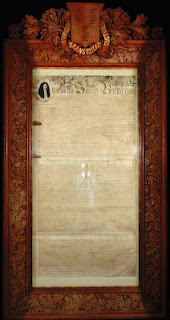
Mary’s sacrifice and civil disobedience worked. After her death in June 1660, a petition to King Charles II resulted in a cease-and-desist order to the Puritan theocracy in New England; and the king’s Rhode Island charter of 1662 (which replaced previous religiously-liberal charters) specifically granted liberty of conscience and separation of church and civil powers in Rhode Island Colony. One hundred thirty years later, the religious-freedom concept modeled by Rhode Island became part of America’s Bill of Rights to the Constitution.

Religious liberties (to practice religion or not without interference of the government) and those who would legislate their morality upon others still clash today, 350 years later. That’s one of the things that compels me to write of a strong-willed woman. Mary Dyer sacrificed her will and her life of ease and wealth, with husband, children, grandchildren, respect and influence for the good of hundreds of people in her own time, and untold hundreds of millions who came after her.

The genealogy hobby is inspiring, educational, and fun. I’m 32 generations down the tree from Eleanor of Aquitaine, Christy English’s muse. Eleanor’s son John was forced to agree to the Magna Carta, a charter of liberties which has been the model of constitutions around the world. On another line, I’m 12 generations down from Mary Barrett Dyer, whose sacrifice laid the groundwork for the human rights in the US Constitution. It’s fun to speculate what molecules of DNA have come down to me from those two, or from the thousands of other strong, resourceful, and intelligent women in the family pedigree. They’re the people whose actions and principles formed our society and culture today. They were not wimps. And neither are we. 


Christy K. Robinson is an author and editor whose book "We Shall Be Changed" was published in hardcover in 2010. She's currently researching and writing a historical novel on Mary Barrett Dyer, 1611-1660.  You can reach Christy at http://christykrobinson.com/#
Christy also has an excellent blog about William and Mary (Barrett) Dyer at http://marybarrettdyer.blogspot.com and I urge you to check it out!
Related Posts Plugin for WordPress, Blogger...