My historical novels Rebel Puritan and The Reputed Wife, Herodias (Long) Hicks Gardner Porter, colonial New England, travels, and whatever else seizes my fancy...

Saturday, November 10, 2012

Can a Willful Wife be Truly Tamed? Let's ask Christy English


How to Tame a Willful Wife
My good friend Christy English has just launched her latest novel, HOW TO TAME A WILLFUL WIFE.  Christy is the author of two excellent novels about Eleanor of Aquitaine.  She has now turned her talent to introducing one of Shakespeare's wildest women into the unsuspecting world of Regency England.


Today it is my great pleasure to let Christy share her thoughts about our favorite strong-willed women, and why we all love them so.  Take it away, Christy!


Strong Women in Fiction: Reflections of Ourselves
Christy English
Author of HOW TO TAME A WILLFUL WIFE

  
Scarlett O'Hara
I have always been fascinated by strong women in literature. Since I was in seventh grade and first read Gone with the Wind, and watched as Scarlett O’Hara destroyed and rebuilt her world time and time again, I have been obsessed with strong characters as they reflect my own strength back to me.

Eleanor of Aquitaine
Of course, it took many years before I realized that these women drew me in because they were an exploration of my own strength and weaknesses. Anytime an author picks up her pen, she explores herself, her own world and her view of it. My fascination with strength in women in my own writing began with Eleanor of Aquitaine, one of the most powerful women in Western European history. She ruled vast territories in her own right, and added to those territories with each marriage, first to the King of France, and later to the King of England.
  
She did not hesitate to leave her first husband when he would not give her a son, and she went on to rule a vast empire at the side of Henry II, while giving him eight living children, seven of whom survived to adulthood. Though her alliance with her second husband fell apart as had her alliance with her first, she went on to rule as Regent for her favorite son, Richard the Lionhearted while he was on Crusade. Eleanor of Aquitaine has held a place in my imagination since I first read about her, reminding me of what it means to be dedicated to a goal, and to work toward it even as it changes beneath you, never relinquishing the final outcome, only letting go of the present obstacles until they can be overcome.
 
Herodias Long - the Rebel Puritan
Herodias in REBEL PURITAN is much like Eleanor in this regard. She is touted as Scarlett O’Hara meets THE SCARLETT LETTER, and that is true. Though she is a woman of her time, she does not allow herself to give up and give in when obstacles rise in her path. She does not hesitate to defend herself or her children, leaving an abusive husband at a time when women simply did not do this.

Now, in my latest novel, HOW TO TAME A WILLFUL WIFE, I find myself in the joyous world of Regency England, exploring the strength of my latest character, Caroline Montague. Another strong woman, she rides a war stallion, fights with a knife and a rapier, and shoots a bow and arrow not just for formal target practice, but hunting from horseback. When her father returns from the Napoleonic wars to arrange her marriage, she finds that the man she is called on out of duty to marry has never known a woman like her. Raised in the wilds of Yorkshire and taught to fight by her father’s veterans, Caroline does not resemble the staid, demure women of the south where Anthony Carrington hails from.

Between them begins a battle of wits and wills as they vie for supremacy. Who will be tamed in the end? My intention was to write a novel in which the male and female leads work out their differences and learn, step by step, moment by moment, to face each other as equals. I can’t speak for Scarlett or Herodias, or even for Eleanor of Aquitaine, but Caroline and Anthony discover that equality in a romantic relationship is a goal worth seeking.

Description of How To Tame A Willful Wife:
1. Forbid her from riding astride
2. Hide her dueling sword
3. Burn all her breeches and buy her silk drawers
4. Frisk her for hidden daggers
5. Don't get distracted while frisking her for hidden daggers...

Anthony Carrington, Earl of Ravensbrook, expects a biddable bride. A man of fiery passion tempted by the rigors of war into steely self-control, he demands obedience from his troops and his future wife. Regardless of how fetching she looks in breeches.

Promised to the Earl of Plump Pockets by her impoverished father, Caroline Montague is no simpering miss. She rides a war stallion named Hercules, fights with a blade, and can best most men with both bow and rifle. She finds Anthony autocratic, domineering, and...ridiculously handsome.
It's a duel of wit and wills in this charming retelling of THE TAMING OF THE SHREW. But the question is...who's taming whom?
 
Link to the novel on Amazon
http://www.amazon.com/gp/product/1402270453/ref=as_li_ss_tl?ie=UTF8&tag=christyenglish-20&linkCode=as2&camp=1789&creative=390957&creativeASIN=1402270453

Christy English
 After years of acting in Shakespeare's plays, Christy English is excited to bring the Bard to Regency England in her romantic re-telling of The Taming of the Shrew, HOW TO TAME A WILLFUL WIFE. When she isn't acting, roller skating, or chasing the Muse, Christy writes historical novels (The Queen's Pawn and To Be Queen) from her home in North Carolina. Please visit her at http://www.ChristyEnglish.com

Friday, October 12, 2012

An Early Quaker "Found Poem"

Quaker women could speak in meeting!
David Teague has kindly assented to let me repeat his recent blog about a poem written by Margaret Fell.  The feelings expressed by Ms. Fell reflect the Quaker belief that women were worthy vessels for God's word.  This countered the Puritan and Anglican conviction that women should remain silent in church.

Herodias Long never heard this poem, but I believe it would have matched her personal beliefs.  And now, here is David's blog post from:  http://davidteague.blogspot.com/2012/10/an-early-quaker-found-poem.html

If George Fox was the father of Quakerism, Margaret Fell (1614-1702), was its mother. In 1666, she published Women's Speaking Justified, the earliest known defense of women's ministry actually written by a woman.

While Margaret's writing style is a bit rambling for modern tastes, and some of her arguments are more clever than profound, some of her language approaches the lyrical. I have always found Margaret's observation that women loved Jesus because he was kind to them, and so they kept faith with him even after he was buried, to be quite moving.

FROM WOMEN'S SPEAKING JUSTIFIED:

Those that speak against
the Spirit of the Lord
speaking in a woman,
simply by reason of her sex,
or because she is a woman,
not regarding
the Seed
and Spirit
and Power
that speaks in her,
such speak against
Christ and his Church. . . .

God the Father
made no such difference
in the first Creation –  
nor ever since –
between the male
and the female,
but always,
out of his mercy
and lovingkindness,
had regard unto the weak.
So also his Son,
Christ Jesus,
confirms the same thing. . . .
Also,
that woman  
that came unto Jesus
with an alabaster box
of very
precious
ointment,
and poured it
on his head
as he sat at meat—
this woman knew more
of the secret power
and wisdom
of God
than his disciples did. . . .
Jesus
owned the love and grace
that appeared in women
and did not despise it:
and he received as much love,
kindness,
compassion,
and tender dealing
from women
as he did from any others,
both in his lifetime,
and also
after they had exercised their cruelty upon him. . . .
Mark this,
ye despisers
of the weakness of women:
if these women
who had received mercy
and grace
and forgiveness of sins
and virtue
and healing from him –  
if their hearts
had not been so united
and knit unto him
in love
that they could not depart
(as the men did)
but sat watching,
and waiting,
and weeping around the Sepulchre
until the time of his Resurrection,
and so were ready
to carry his Message,
how should his disciples have known
(who were not there)?

Image:
http://www.favimp.com/Quakers.html

Friday, September 21, 2012

Why Herodias Long?


Jo Ann Butler

Why Herodias Long?
By Jo Ann Butler
Author of REBEL PURITAN and
THE REPUTED WIFE

I bear genes from Herodias Long and George Gardner passed from son to grandson, down to my maternal Grandma Gardner.  My genealogy research commenced with Grandma in 1978, and quickly led me to The Gardiners of Narragansett by Caroline Robinson.  There I found the George and Herodias as 1630s immigrants from England, but Herodias and her stormy life occupied far more space in the pages than George’s did.

Herodias and her first husband followed religious exiles from Massachusetts to Newport, Rhode Island.  She was married at the age of thirteen, but otherwise Herodias lived a modern life.  Unless they came from a powerful family, 17th-century wives were little more than the property of their husbands, and it was extremely rare for a woman to be granted a divorce unless she was abandoned.

However, Herodias was not afraid to pursue what she needed.  She petitioned for two divorces and was legally parted from both husbands after they proved unsuitable.  She acquired her own land (most female landowners were widows), and retained custody of some of her children.

I admire Herodias for her boldness and persistence, but particularly honor her for an act which does not appear in Rebel Puritan, the 2011 historical novel I wrote about her.  This incredible act of bravery is featured in my sequel, The Reputed Wife, which will be published in autumn, 2012.

Whipping Quakers in Boston
Missionaries from England’s Society of Friends first appeared in Boston in 1656, determined to bring their renewed faith to New England’s Puritans.  They were jailed, but when that did not discourage their acts of civil disobedience, both men and women were whipped with increasing savagery.

Herodias met the Friends – often called Quakers – through Mary Dyer, a Newport resident who had become a Quaker convert in England.  Though she may not have been a convert, Herodias walked fifty miles from Newport to Weymouth, Massachusetts to protest against the brutality, carrying a nursing infant in her arms.

Herodias, the Rebel Puritan
She had seen the wounds borne by Quakers whipped in Boston and New Haven.  She had met Humphrey Norton, whose hand was so deeply branded that he might never use it again.  She knew well that she might receive no mercy from Governor John Endecott and his Puritan magistrates and ministers.  And yet Herodias could not remain silent.

After speaking in Weymouth against the whippings, Herodias was arrested.  She and her maidservant were marched ten miles to Boston, where they were whipped on her naked backs in the street, then jailed for two weeks.

Herodias knew all of this could happen, and yet she spoke.  Some of her other acts scandalized her Rhode Island neighbors and her descendants, but for her courage I honor Herodias (Long) Hicks Gardner Porter.

Images:
Personal collection

Thursday, September 13, 2012

Why Mary Barrett Dyer?


Christy K. Robinson
My guest today is Christy K. Robinson, who is hard at work writing a novel about Mary Dyer.  Mistress Dyer is a well-known resident of Newport, Rhode Island, and is featured in my "Rebel Puritan."  I asked Christy what attracted her to Mary, and she can tell you in her own words:
 
Why Mary Barrett Dyer?

By Christy K Robinson

Historical fiction has been my favorite literary genre since I was a young girl. I’ve learned that several of my author friends read my favorite book series on the Childhoods of Famous Americans when we were kids, and it shaped our discovery of history and historical fiction by humanizing icons of history and making them accessible to children. It tickled our imaginations to learn about culture and what life might have been like for Virginia Dare, Martha Washington, or Abigail Adams, as children. (There were boys in the series, too, of course.)

Mary Dyer and Christy Robinson
My mother was chronically ill, and she drafted me to help her at genealogy and history archives with the fetch-and-carry jobs, or searching the reference files (you know, the little card drawers at the book place, that preceded the search engine). We traced many of our lines back through renaissance and medieval eras to European royalty. One of our most important discoveries in the 1970s was the confirmation that we were 11 and 12 generations descended from Mary Barrett Dyer, the 17th-century Quaker martyr. In the 1970s and 80s, we believed that Mary was hanged by those mean Boston Puritans for her religious beliefs, “simply for being a Quaker.” Unfortunately, that belief persists in countless web pages today.

Mary Dyer had several opportunities to avoid prison and execution. She could have lived her life in peace and safety, doing anything she wanted to, in Rhode Island, the colony she co-founded. But she intentionally returned to Boston several times to defy her banishment-on-pain-of-death sentence, until she forced their hand and they executed her. It’s not that she wanted to die, but that she was willing to die to shock the citizens into stopping their leaders from the vicious persecution of Quakers and Baptists. Whippings such as Herodias Gardner’s. Mary and other Quakers believed they were called by God to “try the bloody law,” the law that required torture, bankrupting fines, exile, and death for dissenters.

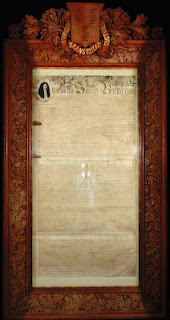
1662 Rhode Island charter
Mary’s sacrifice and civil disobedience worked. After her death in June 1660, a petition to King Charles II resulted in a cease-and-desist order to the Puritan theocracy in New England; and the king’s Rhode Island charter of 1662 (which replaced previous religiously-liberal charters) specifically granted liberty of conscience and separation of church and civil powers in Rhode Island Colony. One hundred thirty years later, the religious-freedom concept modeled by Rhode Island became part of America’s Bill of Rights to the Constitution.

Religious liberties (to practice religion or not without interference of the government) and those who would legislate their morality upon others still clash today, 350 years later. That’s one of the things that compels me to write of a strong-willed woman. Mary Dyer sacrificed her will and her life of ease and wealth, with husband, children, grandchildren, respect and influence for the good of hundreds of people in her own time, and untold hundreds of millions who came after her.

The genealogy hobby is inspiring, educational, and fun. I’m 32 generations down the tree from Eleanor of Aquitaine, Christy English’s muse. Eleanor’s son John was forced to agree to the Magna Carta, a charter of liberties which has been the model of constitutions around the world. On another line, I’m 12 generations down from Mary Barrett Dyer, whose sacrifice laid the groundwork for the human rights in the US Constitution. It’s fun to speculate what molecules of DNA have come down to me from those two, or from the thousands of other strong, resourceful, and intelligent women in the family pedigree. They’re the people whose actions and principles formed our society and culture today. They were not wimps. And neither are we. 


Christy K. Robinson is an author and editor whose book "We Shall Be Changed" was published in hardcover in 2010. She's currently researching and writing a historical novel on Mary Barrett Dyer, 1611-1660.  You can reach Christy at http://christykrobinson.com/#
Christy also has an excellent blog about William and Mary (Barrett) Dyer at http://marybarrettdyer.blogspot.com and I urge you to check it out!

Monday, September 3, 2012

Strong-Willed Women


It’s been a while since I added to this blog.  I’ve been hard at work on preparing to publish The Reputed Wife, my sequel to Rebel Puritan, but other aspects of life have intruded as well.  My 81-year old mother went missing for 18 hours on a drive from southern Pennsylvania to upstate NY, and what should have been a 250-mile trip turned into nearly 700.  She is fine now, but after that scare, my family is assessing her abilities and needs.  One thing I can tell you – no more long-distance solo drives for her!

Suffragettes
My mother is delightful and engaging, but anyone who has ever known her can attest that she is a strong-willed woman.  People have said that about me as well.  Is that why I was drawn to write about Herodias Long? 

That 17th-century woman grabbed me with her thoroughly modern exploits the moment I read about them, and I am still in her thrall.  What is it about Herodias which attracts me so?  I questioned a pair of friends who are writing about their own strong-willed women, and their answers are similar to mine. 

Christy English


Christy English has written two books about Eleanor of Aquitaine; To Be Queen and The Queen’s Pawn.  Why Eleanor?  I’ll let Christy tell you herself:


Why Eleanor of Aquitaine?
By Christy English
Author of TO BE QUEEN

Eleanor of Aquitaine
Why does Eleanor of Aquitaine enthrall me? This is a question with so many answers, that I’ll only talk about a few of them here. Eleanor amazed me with her power. In spite of the fact that she was born a woman during the high Middle Ages, she ruled the Aquitaine and Poitou in her own right, inheriting her property directly from her father. She managed to keep hold of her lands even after her marriage to her first husband, King Louis VII of France, was annulled.

Eleanor of Aquitaine was a powerful woman, but she was also a cultured one. She kept the art of courtly love flourishing both in England and in France, and carried it all the way to the gates of Byzantium when she rode in the Second Crusade. Eleanor was a woman who knew what she wanted. As soon as she freed herself from her first marriage, only two months later, she married Henry, the eighteen-year-old Duke of Normandy who within two years time was crowned King of England.

There are so many reasons to love Eleanor. My favorite reason is that she never gave up. No matter what obstacle rose in her path, she did not relinquish her goals. She simply waited and bided her time until she could bring her dreams to fruition. Not every task she set herself was accomplished, but most of them were. That determination, more than her lands and her titles, made Eleanor of Aquitaine a woman to be reckoned with.
Eleanor's effigy at Fontrevaud Abbey

Images:
personal photos and collection from Christy English


Related Posts Plugin for WordPress, Blogger...