My historical novels Rebel Puritan and The Reputed Wife, Herodias (Long) Hicks Gardner Porter, colonial New England, travels, and whatever else seizes my fancy...

Tuesday, February 21, 2012

Everglades' Top Predator


Full moon in the Everglades
On the night of February’s full moon, Richard and I went for a ranger-led walk at the Everglades National Park in Florida.  Our group strolled along the Anhinga Trail boardwalk, and though we are in the heart of winter, we heard a dozen different insects chirping and buzzing.  Anhingas and herons croaked gutturally, complaining about our disturbance – or was it a night-prowling predator?

Anhinga at night
Predators abound in the Everglades, most of them nocturnal.  The region’s few panthers and bears are rarely seen.  Raccoons and smaller scavengers are also rarer than they used to be, thanks to one of the park’s newest predators – the Burmese Python.  These monsters arrived in the park as unwanted or escaped pets, and are now a permanent part of Florida’s ecosystem.  They grow up to 30’ long, and will eat anything they can swallow. 


Everglades Burmese Python (photo from USA Today)
Pythons’ numbers are estimated at 10,000 – 100,000, which means that nobody really knows how many of these voracious snakes are in southern Florida.  (Ironically, the pythons are endangered in Burma)  Also, nobody knows how far north they will eventually range – South Carolina?  Virginia?  What the specialists do know is that deer, herons, small mammals, and even alligators are on the pythons’ menu.

Alligator eyeshine
The coolest thing Richard and I learned is that alligators’ eyes reflect light, glowing red when we aim our flashlight at them.  These reptiles lounge at the top of the Everglades food chain, and will eat anything they can swallow (including pythons).  They are a keystone species for the region, because much of the Everglades’ wildlife can’t survive without alligators.  They dig holes which retain water through the driest months, providing that precious commodity for fish, birds, turtles, and all types of animals.  If a few of those animals feed the owner of the gator hole, then that’s how the food chain works.
This photo shows the most feared critter in the Everglades.  No, I’m not talking about the big lizard – check the enlargement.   Caught in my camera’s flash is the park’s most dreaded predator  – the mosquito.  They aren’t so bad in the winter – there are only a half dozen of them in my photo – but when the wet season arrives, I will not be standing here.  

Mosquito lunchtime
There are 43 species of mosquito in southern Florida.  They hatch in salt or fresh water, and in 13 of those species, females bite people for a blood meal to perpetuate their species.  Florida’s sprawling coastal cities depend on two things to make them habitable – air-conditioning and insecticide.

I submit to you that mosquitoes are also keystone species for the Everglades.  How much of the park would still exist without them?  A few choice hardwood hammocks, perhaps the most inaccessible marshes, but humans have already dug, diked, and drained ¾ of the Everglades.  Perhaps the only thing that stops the rest of that beautiful, austere ecosystem from being turned into farmland or housing tract is the humble mosquito in its uncountable trillions.

Thank you, Madame Mosquito, for saving the Everglades from development.  Thank you, dry season, for knocking down the bloodsuckers’ numbers to tolerable levels so we humans can visit this incredible place.  Now, let me out of here before the rains begin, and the Everglades’ true rulers take to the air – the mosquitos.

Tuesday, February 7, 2012

Dancing With Vultures and Tickling Crabs

Miami evening
TV shows such as “Miami Vice” give us the impression that southern Florida is nothing but an urban jungle.  There is more than enough development and cityscape, but Richard and I love SoFL for its untamed lands.  Winter is by far the best time to see Florida’s wild beauty, and we are making the most of it.

West Lake trail at Everglades NP
Western forests and deserts are untamed enough to satisfy most people, but southern Florida dishes out the wild like no place else.  Under the best of circumstances Florida's wetlands are hard to access.  Many parks have boardwalks to access their tangled mangrove swamps.  I know a few tough people who have walked through mangroves, but let’s just say that they had compelling reasons to do so.  I haven’t tried it yet.

You need a boat to see much of the Everglades and mangrove swamps, and even a sturdy craft doesn’t make it easy.  Canoeing the Everglades’ sawgrass prairie is delightful as long as you don’t run out of water – a concern during Florida’s dry season.   It also pays to keep an eye on the tide.
Everglades sawgrass

Wood Stork
Southern Florida’s wildlife is simply incredible.  There are many great places to see critters, but the Everglades is king of them all.  The early ‘Glades had few dry places, but there is now a single road which gives access to the park.

Just about everything in SoFL - roads, buildings - lies upon heaped up coral rock, and the ditches and holes which supplied that rock are now filled with water.  Those ditches are now waterways teeming with animals which are so accustomed to people in the Everglades park that you can watch them go about their lives only a few feet away.  Some people get far too close.   Winter’s dry weather concentrates birds, fish, turtles, and alligators in areas with water, so Anhinga Trail and Shark Valley are world class animal-watching spots.

Big alligator at Anhinga Trail
Germany's most stupid tourist


Black vultures are prominent at Anhinga Trail.  They have a peculiar habit of dismantling parked vehicles, especially windshield wipers.  One could say that vultures really do enjoy a good tailgate party, and removal of weatherstripping is their version of Pin the Tail on the Donkey.  The park provides tarps to people who want to protect their vehicles at Anhinga Trail.  At more remote locations we wrap the wipers with plastic bags, hoping the fluttering will scare the vultures off.  Limited success there - they are they are picking the caulk from our camper.
 
Atala butterfly
I am a long-time birder, and have added butterflies to my search-and-identify mania.  Florida has butterflies like no other place, and this year there is a bumper crop.  It is much safer to get close to butterflies than alligators, and I am making the most of it.  This friendly fellow is called The Monk.

Butterflies aren’t the only things I’ve picked up over the years – sea hares, non-poisonous snakes – anything that lets me get close enough.  I added a new critter to my portfolio a few days ago when I learned how to entice a tree crab.  Slide my hand up the crab’s mangrove perch from below gently enough, and I can persuade it to transfer to my fingers.  There, it daintily picks at my skin with tiny claws unless I get the camera too close.  That giant eye is a threat, and the crab launches itself into space, down to the safety of the mangroves and mud.

Monday, January 30, 2012

Long Miles and Big Days

Getting from upstate New York to southern Florida in January is no mean feat.  Our chosen route was I-81, where Richard and I faced potential nasty driving conditions in the Poconos, the Appalachian foothills of Virginia or Tennessee, and even the hills south of Syracuse.  So we chose a departure day when the skies were clear and the roads were dry.  Fourteen hours later, we pulled into our friends’ driveway in Jefferson City, Tennessee.

Richard and Miss Kitty
I’ve known Anne and Greg since 1976.  I took riding lessons from Anne, then boarded my half-Arabian hunters with them. They still have horses, cats, and dogs, and they surely have good karma in abundance, since they take in any animal with a sad story.  Miss Kitty is typical – she is at least 16 and has no teeth, but she is content, and just loves Richard!

We played with the Woodruffs’ animals, and they came with Richard and me to look for a super-rare hooded crane at Hiwassee Wildlife Refuge.  This Asian bird must have turned its mental migration map upside-down, for not only is this its first North American appearance, but it turned up a good 10,000 miles from its home range, in the company of 12,000 sandhill cranes.  We missed seeing the bird after a 3-hour wait on a bone-chilling day.

Hooded Crane
Two days later, Richard and I drove another 120 miles one-way for another try.  This time the crane obliged, but 15 minutes after our arrival rain began pounding down.  An hour later it changed to snow.  We had to wait until noon the next morning to leave our friends’ home, because the road crew waits for snow to melt on secondary routes, rather than salting them into submission like they do in NY.

Red Clay State Park
This made for another tough driving day.  We had a brief stop at Red Clay State Park, where Cherokees gathered after being ruthlessly ejected from their lands in Georgia, and prepared to take the Trail of Tears to Oklahoma.  Then we blasted south to Columbus, GA.

FDR's bedroom at Warm Springs SP
Richard and I played with my cousins for a few days, and I saw FDR’s home at Warm Springs, GA for the first time.  An amazingly humble place, it reminded me of my family’s childhood camp (though with better china).  FDR’s bedroom showed that even a president can sometimes get away from all of the pomp and formality.

Infantry museum - Ft. Benning, GA
We also took in the Army’s Infantry Museum at Ft. Benning.  I was disappointed because exhibits for the colonial, Revolutionary, and Civil wars were not finished, and I wanted to see what information they had on New England’s 1675-6 King Philip’s War for my Rebel Puritan sequel.  But it is a fascinating museum, and after spending extra time in the WWII barracks tour and talking with a Vietnam War veteran/docent we weren’t able to finish seeing the place.  Something to look forward to…

Jimmy Carter NHS
Another long drive southward to Plains, GA and the Jimmy Carter National Historical Site.  The high school which Jimmy and Rosalynn attended is now the visitor’s center.  We also toured Carter’s boyhood farm and even saw exhibits in Billy Carter’s gas station.

Eerie Apalachicola activities?
We ended our day after dark in a primitive campsite in the Apalachicola National Forest outside of Tallahassee, Florida.  This is our favorite sort of camping – nobody within miles (except for pre-dawn hunters and baying hounds). I wondered what sort of party had occurred in our campsite before we were there – the site was littered with fish bones and oyster shells, a pig’s skull, a flattened super-size, manly-type deodorant can, over a dozen snuff cans, and too many beer bottles to count.

Old Florida capitol building
Now Richard and I could explore Tallahassee (and I had my first chance to catch up on email at a library).  The old Florida state capitol building is now a museum.  The new capitol is a drab office building, but with a fabulous view on the 40th floor.

Apalachee Mission council hall
Apalachee council hall interior
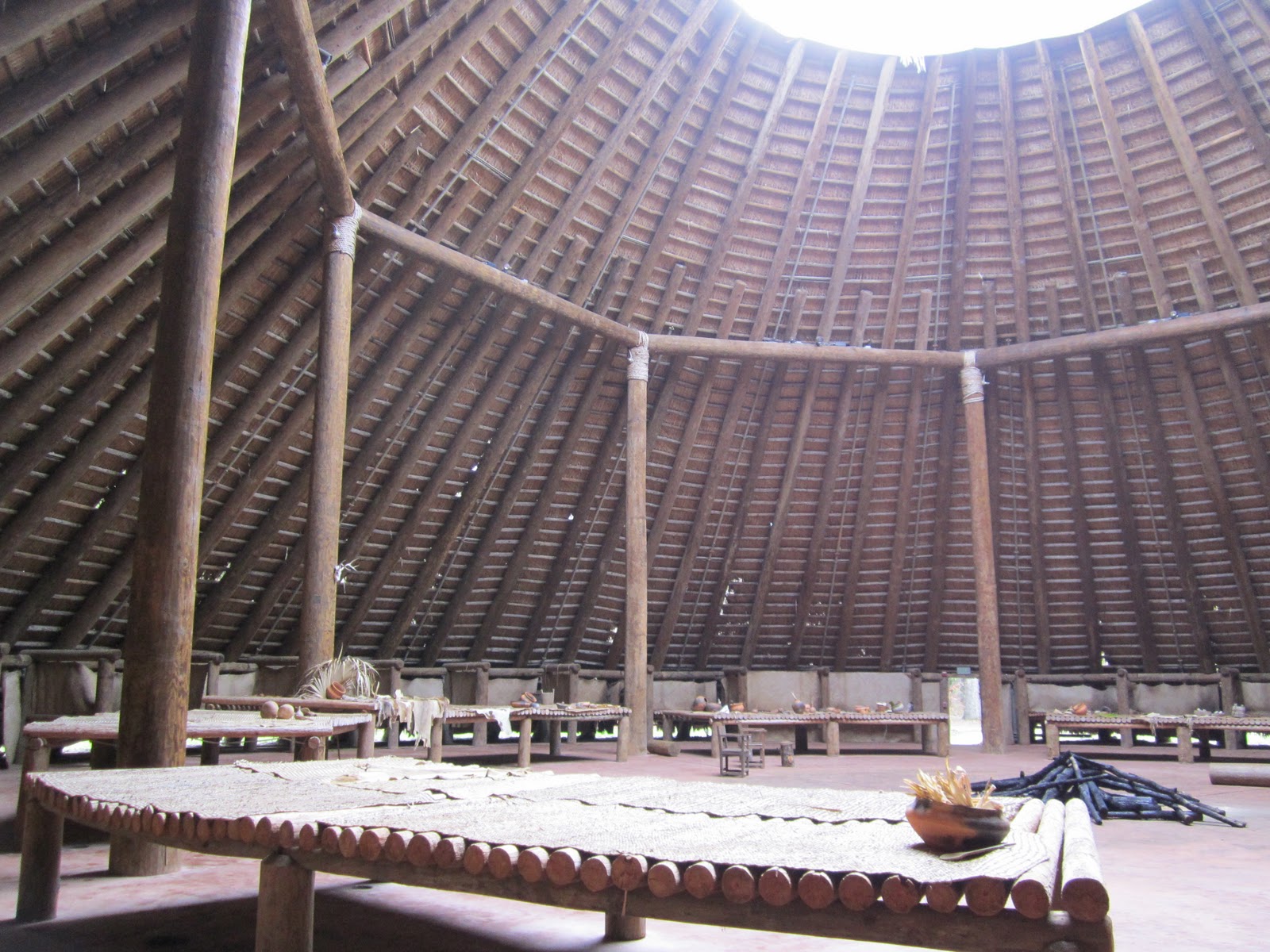
It seems that school children and the odd tourist are the only visitors to the Apalachee Mission State Park. Too bad – the recreated log and palmetto-frond council building built by the Apalachee Indians is unique, and deserves to be more widely known.


St. Marks National Wildlife Refuge is on Florida’s northern Gulf Coast, and is a can’t-miss attraction.  After seeing my first Florida golden eagle and a very unusual wintering roseate spoonbill, I decided to have a Big Day, and count every bird species I could find.  This test of detection and identification skills had me listening to every peep and rustle in the bushes until 10:30 pm when I heard my final birds – a barred owl hootenanny.  Between pinewoods, marshes and coastal waters, I ended my big day with 96 species.  Not bad for winter birding (and no scope to identify those ducks diving offshore).
Roseate Spoonbill (Wikipedia)
lighthouse at St. Marks NWR

Rainbow Springs State Park

Manatee (marinelife.about.com)
It took Richard and me another five days to get from Apalachicola to Fort Lauderdale.  The distance can be driven in one day, but we filled each day with natural wonders, and camped in state parks so it took longer.  Entire rivers flow from clear blue springs and live oaks draped with Spanish moss beg to be photographed.  People bending over a bridge railing alerted us to several manatee sightings, as the gigantic creatures warm up in the balmy spring water.
 
Gumbo Limbo tree
Ding Darling NWR at sunset
Sanibel Island is another of our favorite spots, and it would be nice to spend a few days there in another lifetime (perhaps when I start selling books like J.K. Rowling).  Ding Darling National Wildlife Refuge occupies nearly half of the island, and we spent half of our day on the island in the refuge.  Egrets, spoonbills, white pelicans, and other waders abound; exotic tropical vegetation brings out the photographer in us, and it’s hard to take a bad picture at sunset.

Cypress & strangler fig
Image by Greg Lavaty at www.pbase.com
Our last adventure before reaching Fort Lauderdale was at Audubon’s Corkscrew Preserve, one of the largest surviving virgin cypress forests.  We were greeted at the visitor’s center with three pair of painted buntings at the bird feeders, and we never stopped taking photos even when it began to rain. 

bromeliad
So, having pounded out nearly 2,000 miles and flattened our feet on miles of boardwalks, Richard and I are resting for a couple of days at Fort Lauderdale.  I managed to review 4 chapters of my Reputed Wife manuscript on the road, but more awaits. Our next stop?  The Everglades for more birding, photography, and mss review - Huzzah!

Tuesday, January 24, 2012

Why Puritans Scare Me


As readers of this blog may have figured by now, last year I published a historical novel based partially in 17th-century Massachusetts.  You might even have noticed that I am sometimes critical of the Puritans who controlled that colony in that time.  Why is that, and what do we know about Puritans?

They hated sex, right?  Hardly.  There was a proper time for sex; after marriage.  But premarital sex was not unknown, and up to 20% of some towns’ births came within 9 months of marriage.  You might be fined, or possibly jailed for extramarital sex, but that was about it.

They hated alcohol?  Not at all – weak beer or cider was what most people preferred.  Milk was for children.  Water was sometimes contaminated, so it was considered unhealthy.  However, drinking alcohol to excess was frowned upon, and drunkenness was a good way to get hauled off to jail.

Then … what do we remember the Puritans for, and why do they scare me?  This is why:

Salem Witch trial
Puritans ran the horror show we remember as the Salem Witch Trials, when scores of New Englanders lost their lives, liberty, and estates as witches.  Often, the evidence was nothing more concrete than a pre-teen crying out that an accused person’s “specter” had attacked her.  In the Puritans’ defense, the judges, magistrates, and ministers were all convinced that they were saving Massachusetts from Satan, pursued “witches” throughout the colony until the royal governor ended the witch hunt (after his wife was accused).

The witch hunts began in 1692, but the real-life heroine in my book, Herodias (Long) Hicks, was witness to a much earlier abuse of power by the Puritans.  In 1637, less than a decade after Boston was established, citizens who supported a fiery, controversial sermon critical of the Puritans had their weapons seized, and were then given a choice.  Recant or depart.  Many apologized and were allowed to stay.

Anne Hutchinson's trial
However, many of Herod Hicks’ friends chose to leave Massachusetts, and several were banished to ensure that they could never return.  Anne Hutchinson was also excommunicated for heresy.  These tough New Englanders went south to begin their own new colony at Rhode Island.  Herod’s family joined them not long after.

Why did the Puritans do this?  Because they so dearly wanted their own colony that they left their homes in England, sailed across the Atlantic, and built new homes in the Massachusetts wilderness.  The Puritans now had their “City upon a hill,” as John Winthrop put it; a Godly community which would provide an example to the rest of the world.  Far from easy interference by King Charles, Church of England moderates, or Parliament.  Free to choose – or eject – what sort of people were allowed to dwell among them.  When Anne Hutchinson’s supporters became numerous enough to vote Winthrop out as governor, they had to go.

They were also free to make their own laws, based directly on English law, but also upon the Bible, particularly from Deuteronomy.  The proscriptions and punishments spelled out there are often harsh, yet our Puritan ancestors tried out many of them.  They were hardly the first; people have been mutilated and slain for their beliefs for millenia.  But the Puritans brought Old Testament law to New England, justifying their actions by saying that God would punish New England's residents far more harshly than they did.

Gays and adulterers were hanged.  Thieves and heretics – those who held “dangerous” (non-Puritan) beliefs – were branded or whipped so their scars would prove them suspect in the future.  Quakers had their ears cut off.  Witches were burned – 

witch burning image from PhotoBucket
OH NO, THEY WEREN’T!  Not a single “witch” was burned in New England.  A few dozen were hanged over the years, but burning witches was a European thing.

The Puritans were also creative in their methods of persuasion.  A disobedient child might have his heels tied to his neck, and left in that excruciating position until the blood “started” from his nose.  Spare the Rod, Spoil the Child is a good old-fashioned Puritan concept.  Headstrong kids quickly learned to obey, and it’s just as well, because they could be executed.  Even an adult could be hanged for disobeying his or her parents.

image by Dave Doody from http://www.history.org/foundation/journal/spring03/branks.cfm
Wayward adults could be punished in many ways.  Fasten a drunkard’s feet into the stocks, or lock his head and hands in the pillory, and let him stand in public for an hour or two.  Does a woman argue with her husband too much?  Pinch her tongue in a split stick and display her for public ridicule.  Women really did wear the Scarlet Letter for adultery.  And when one old man refused to enter a guilty or not-guilty plea during the Salem witchcraft outbreak, the Puritan magistrates piled rocks on his chest, trying to press the words out of him.  The man died before he gave them the satisfaction.

Those acts were based on biblical law, as interpreted by Massachusetts’ Puritan ministers.  Now, some people might say that we need more biblical law in our lives. However, there really can be too much of a good thing.

For Massachusetts’ first decades, the same handful of men oversaw everything: enacting and enforcing laws, deciding who was permitted to own land, and who could preach – Puritans only, thank you.  Once found acceptable, those clergymen interpreted the Bible for the magistrates when new laws were being written.  Puritan ministers also decided if a man’s beliefs were conventional enough to let him join the church.  Take note: if that man were not a church member, he could not vote.  Thus the church upheld the colony’s laws by barring the non-orthodox.  In turn, the colony supported the church and its ministers through taxes.

Single party rule from courthouse to meetinghouse can – and did – lead to spectacular abuse of power.  Convinced that God was on their side, and that achieving a “pure” New England justified whatever it took to keep outsiders from their midst, Puritan intolerance led to repeated purges of those found not acceptable – Catholics, Jews, Baptists.  Five Quakers, including Mary Dyer, were hanged when they refused to accept banishment from Massachusetts.

Such overwhelming abuse is less likely in this country these days … thanks to liberal courts, conservative judges, and progressive laws, moderates and hawks of all sorts.  Even Occupy Wall Street protestors and Tea Partiers have a part to play when they point out wrongs.  But the McCarthy hearings are not far in our past, when people suspected of “Communist” leanings saw their careers ruined. Internment camps in WWII …

When you come to it, it’s extremists of all sorts that scare me, not just Puritans, or Taliban, or the Spanish Inquisition.  While I wish that our representatives could get their heads together and solve our country’s problems, hopefully no single group can get enough advantage to do the Puritans’ sort of damage – not without being checked by the rest of us.  There really is strength in diversity.

Related Posts Plugin for WordPress, Blogger...