My historical novels Rebel Puritan and The Reputed Wife, Herodias (Long) Hicks Gardner Porter, colonial New England, travels, and whatever else seizes my fancy...

Thursday, October 31, 2013

Witches vs Winthrops


A witch with her familiars

Seventeenth-century folk believed strongly in divine forces beyond their understanding. Though we now understand earthquakes, lightning, hurricanes, and birth defects to be natural occurrences, those phenomena were thought to be created – and aimed at humans – by both God and Satan. Witchcraft was another force believed to be very real, especially by New England’s Puritans.

The first accusation of witchcraft in New England occurred in 1638, eight years after the settlement of Massachusetts. Several months before April 4, 1638, Mary Dyer of Boston bore a deformed child. The stillborn infant was secretly buried, but when word leaked out, it was exhumed. Governor John Winthrop recorded the investigation of this ‘supernatural’ birth in his journal [All of Winthrop’s accounts are edited here]:

Midwives
The wife of one William Dyer had been delivered of child some few months before, October 17, and the child buried, (being stillborn,) and viewed by none but Mrs. Hutchinson and the midwife, one Hawkins's wife … The midwife, after this discovery, went out of the jurisdiction; and indeed it was time for her to be gone, for it was known that she used to give young women oil of mandrakes and other stuff to cause conception; and she grew into great suspicion to be a witch, for it was credibly reported, that, when she gave any medicines, she would tell the patient if she did believe, [Hawkins] could help her.

This was the first suspicion of witchcraft recorded in New England. Jane Hawkins sensibly fled to Portsmouth, Rhode Island. If there was ever an accusation of witchcraft within Rhode Island, it was not given enough credence to enter the colonial record.  Rhode Island’s Puritan neighbors could not say the same.

MA governor John Winthrop
In summer 1640, Winthrop mused about a second woman skilled in midwifery. Anne Hutchinson once dwelt in Boston, but when she began interpreting Scripture to a large party of followers she was purged, along with any adherents who would not recant. Much of Anne’s party settled Portsmouth, Rhode Island. Puritans suspected that Anne Hutchinson used witchcraft to sway others to her beliefs, and Winthrop’s voiced his thoughts in his journal:

Mr. Collins, a young scholar full of zeal, and one Mr. Hales (a young man very well conceited of himself and censorious of others) went to Aquiday [Rhode Island], and so soon as Hales came acquainted with Mrs. Hutchinson, he became her disciple. These [influences], and others when [Hutchinson] dwelt in Boston, gave suspicion of witchcraft.
June 4, 1648: This time Winthrop, who still governed over Massachusetts, elaborated on a woman who was executed for witchcraft in his own colony: At this court one Margaret Jones of Charlestown was indicted and found guilty of witchcraft, and hanged for it. The evidence against her was:

 1. She was found to have such a malignant touch, as many men, women, and children whom she stroked or touched with any affection or displeasure were taken with deafness, or vomiting, or other violent pains or sickness.
 2. Her medicines being such things as were harmless, as aniseed, liquors, etc., yet had extraordinary violent effects.
3. She would tell such as would not make use of her medicine that they would never be healed, and accordingly their diseases and hurts continued, with relapse against the ordinary course, and beyond the apprehension of all physicians and surgeons.
 4. Some things which she foretold came to pass; other things she could tell of (as secret speeches, etc.) which she had no ordinary means to come to the knowledge of.
5. She had an apparent teat in her secret parts as fresh as if it had been newly sucked. After it had been seen upon a forced search it was withered, and another began on the opposite side.
6. In the prison there was seen in her arms, she sitting on the floor, and her clothes up, etc., a little child, which ran from her into another room, and the officer following it, it vanished. The like child was seen in two other places, and one maid that saw it fell sick and was cured by the said Margaret.

Her behavior at her trial was very intemperate, lying notoriously and railing upon the jury and witnesses, and in the like distemper she died. The same day and hour she was executed, there was a very great tempest at Connecticut, which blew down many trees, etc. 

Witch with familiar spirits
To 17th century Puritans, Margaret Jones exhibited classic signs of a witch: a familiar spirit by which she communicated with Satan, a witch’s teat created by suckling the devil (probably a skin tag resulting from childbirth), supernatural knowledge and skill in medicine, and the ability to sicken and kill merely by touching.

However, after the hanging of Margaret Jones, there were no more executions in Massachusetts during John Winthrop’s life. He was a keen observer of natural – and supernatural – phenomena, but apparently not a strong believer in witchcraft. He did not possess the persecuting zeal of Governor John Endecott, who sent four Quakers to the gallows between 1659 and 1661, including Mary Dyer of Newport, Rhode Island. Herodias (Long) Gardner of Newport was one of dozens who stood at the whipping post for preaching or defending Quaker beliefs. Neither did Winthrop have the credulity of Governor Simon Bradstreet, who oversaw the Salem witchcraft hangings in 1692.

John Winthrop died in 1649. He apparently came to regret his earlier persecution of Anne Hutchinson and her followers, Anabaptists, and other free thinkers. It was reported that Winthrop was asked to sign an order of banishment while on his deathbed. He refused, saying, “I have done too much of that work already.”

CT governor John Winthrop
In 1650, his son John Winthrop removed to the fledgling town of New London, Connecticut. In 1651 he became a magistrate in the Connecticut government, and on May 21, 1657 John Winthrop, Junior no longer because his father was dead, was elected Governor of Connecticut.
Before the notorious 1692 outbreak in Salem, Massachusetts, Connecticut was the hotbed of New England’s witchcraft. Not every convicted person on this list was executed, but those known or strongly suspected of having died are in red:


Young, Alice
1647
Hanged
Johnson, Mary
1648
Hanged
Bassett, Mrs.
1651
Hanged
Carrington, Joan
1651
Hanged
Carrington, John
1651
Hanged
Goodman, Elizabeth
1653, 1655
Convicted
Knapp, Goodwife
1654
Hanged
Gilbert, Lydia
1654
Hanged
Mary Staples
1654
Accused
Bailey, Mrs. Nicholas
1655
Convicted
Bailey, Nicholas
1655
Convicted
Meaker, William
1657
Convicted
Palmer, Katherine
1660, 1672
Accused
Jennings, Nicholas
1661
Tried, found not guilty
Jennings, Margaret
1661
Tried, found not guilty
Ayers, William
1662
Accused, fled
Ayers, Goodwife
1662
Accused, fled
Greensmith, Nathaniel
Greensmith, Rebecca
1662-3
1662-3
Hanged
Hanged
Barnes, Mary
Mary Sanford
1662-3
1662-3
Hanged
Hanged
Wakeley, James
Sanford, Andrew
1662-3, 1665
1662-3
Accused, fled
Tried, found not guilty
Seager, Elizabeth
1662-3, 1665
Convicted
Grant, Mrs. Peter
1662-3
Accused
Varleth, Judith
1662-2
Tried, found not guilty
Blackleach, John
1662-3
Accused
Blackleach, Elizabeth
1662-3
Accused

Connecticut’s Puritan magistrates and ministers fervently prosecuted alleged witches, and seven women were executed for witchcraft before 1657. In May of that year, John Winthrop became Connecticut’s governor. He was elected again in 1659, and remained governor until his death in 1676. Notice that in the list of witches, there were no hangings between Winthrop’s election and 1662.

However, from mid-1662 through much of 1663 there was a major witchcraft outbreak which resulted in four executions. It began when eight year-old Elizabeth Kelly died after several days of severe stomach pain. An autopsy determined that the girl died of ‘preternatural causes,’ and before her death, Betty Kelly repeatedly accused Goodwife Ayres of witching her to death. 
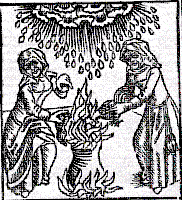
Witches' cauldron
The evidence against Goody Ayres is scant – she ate broth from a boiling kettle and shared it with Betty. When the girl fell ill many hours later, her parents no doubt questioned her closely about who was tormenting her. Betty told them that Goody Ayres was kneeling on her belly and pinching her. After Betty’s death, the blood pooled in her arms looked like bruises – evidence that Goody Ayres’ specter had indeed pinched Betty.

Soon another ‘possessed’ girl, Ann Cole, cried out on Elizabeth Seager, Goodwife Ayres, Rebecca and Nathaniel Greensmith, Mary Sanford, and others. William Ayres and his wife saved their lives by fleeing to Rhode Island. The Greensmiths, Mary Sanford, and Mary Barnes stayed in Hartford, were tried and convicted, then executed. Accused witches pointed fingers at their neighbors, and a score of people awaited their fates in jail. It seemed that there would be no end to the trials and executions.

Alchemist - Teniers
Walter Woodward, Connecticut state historian, notes that Governor John Winthrop Jr. “drew on his own fascination with alchemy and magic to save, rather than condemn, the accused.” Winthrop was a physician and an alchemist. Alchemy is the study of chemistry and minerals, with an eye to magically transform base metals to another element – gold. Some alchemists were accused of witchcraft, but Winthrop was fascinated by the notion. He was no magician or witch, and he used that knowledge to block trials and overturn convictions.

So, what happened to Governor Winthrop’s benign influence during the 1662 outbreak? John Winthrop had gone to England in 1661 in search of a royal charter for Connecticut. Though he was elected in absentia, Winthrop did not return until 1663, after four people had already been executed. After Winthrop’s return, the remaining trials were quickly concluded and convictions dismissed.

The 1662 Hartford witchcraft outbreak is of particular interest to me because Herodias (Long) Gardner, my favorite obsession, has a Connecticut witch connection. Herod’s son George was called to court in October, 1662 to answer for reproaching Rhode Island’s Governor Benedict Arnold a few months earlier. George was only fourteen, and was found not guilty, no doubt after apologizing for his rash words.

John Smith was not so lucky. For the same offense, the Rhode Islander had to pay a bond of £20 to ensure his future good behavior, and to nail up an apology on the jail house door. At Smith’s trial, it was revealed that he’d accused governor Arnold of issuing a “warrant to apprehend the wife of William Ayres who was sent after from Conneticott for breaking prison, & that having given out his warrant did send private notice to sayd Smith’s house that the woman might be convayed away so to escape the said warrant.”  I surmise that Governor Arnold did not believe in witchcraft either. While he was duty-bound to arrest a jail-breaker, it appears he warned the Ayreses so they could escape a spurious, and potentially lethal accusation.
Trial by Water
Goodwife Ayres (whose first name I cannot learn) is the same unfortunate woman accused of witching Betty Kelly to death in 1662. The Ayres couple may also have been subjected to the ‘swimming test.’ A letter written by Rev. John Whiting of Hartford to Rev. Cotton Mather of Boston, tells us that, “some had a mind to try whether the stories of witches not being able to sink under water, were true; accordingly a man and woman [accused by Ann Cole] had their hands and feet tied, and so were cast into the water, and they both swam after the manner of a buoy.’  Fortunately, that feeble evidence was not deemed legal means to convict the unhappy couple. 

However, Goody Ayres was jailed for trial in Betty Kelly’s death. A neighbor said he saw her dancing around a steaming cauldron with other witches. Another testified that Goody Ayres told her she had been courted by Satan in London. 

It looked grim for Goodwife Ayres until her husband William helped her escape from Hartford’s jail. The unhappy couple fled to Rhode Island, and with the help of Herodias Gardner and her family, disappeared from New England. I am featuring this incident in The Golden Shore, the sequel I am currently writing to Rebel Puritan and The Reputed Wife, my historical novels about Herodias Long.


Sources:
Witch-Hunting in Seventeenth-Century New England  David D. Hall  1991
The Witchcraft Delusion in Colonial Connecticut  John M. Taylor  1908

Monday, October 7, 2013

Genealogy à la Carte


Three years ago I created a Facebook page for Herodias Long of 17th century Rhode Island, the real-life protagonist in my Scandalous Life series. That page, along with my Rebel Puritan website and blog, serve to disseminate and solicit information about Herodias and her husbands, John Hicks, George Gardner/Gardiner, and John Porter.

Since I published Rebel Puritan in 2011, I’ve had many a pleasant exchange with other Herodias descendants and friends. I use information gathered in 35 years of research to answer questions about Herodias and her family, and some genealogists and descendants have new data for me. Some of them have also triggered lively debate.

John Hicks and Harwood Long
I swapped emails with a noted genealogist bent on convincing me to stop using the name Herodias for my ancestor, in favor of Harwood. He reasons that because the woman was named ‘Harwood’ on her marriage license allegation, that is what we should all call her. He wants me to print inserts for unsold books correcting my protagonist’s name, and to send an apology to my buyers.

Herodias used a shortened version of that unsavory name from the Bible, so she is seen in Rhode Island records as Horod or Horred, and even Harwood. Her descendants supplied ‘Herodias’ to 19th century genealogists as their notorious great-grandmother’s proper name. Perhaps I’m propagating a fictitious name, but I believe that there is greater harm done by discarding a name which is indeed fact.

A couple of weeks ago a man posted on my Herodias Long Facebook page, asking why I 'claim' to be descended from Herodias. After all, I admit that I am descended from her son Benoni Gardner. He reasoned that Benoni means ‘son of my sorrow or pain’ and adds, “It's a name given after the mother or father dies. It's a well known fact that … George Gardiner's [first] wife died at sea, and their child was named Benoni because of the loss.”

NEHGS logo
I supplied him with a link to an article printed by no less than the New England Historical and Genealogical Society ("O My Son Benoni"). It states that boys were also named Benoni when they seemed likely to die, they were conceived out of wedlock, or were named for relatives.

My 7th great-grandfather Benoni was indeed conceived to Herodias and George Gardner in a very troubled time. Herodias had recently been abandoned by her first husband, John Hicks. John also took their children, and she did not learn where they were for several months. It seems that she turned to George for comfort, and gained a son in the bargain.

My Facebook correspondent was not impressed by my reasoning, and replied, “Believe what you want about your heritage, and I will believe the records I have.” He had plenty to say about the fictional content of Rebel Puritan and The Reputed Wife, but I’ll save that for another post.

“I will believe the records I have.” This man bases his belief on the notion that 'Benoni' was  reserved for sons of dying mothers – even though there are other reasons that boys are named Benoni – and cites a “massive online group” who share his belief.

Methuselah
People have compiled their genealogies since before the Bible was written. Ever since, they have squeezed, stretched, and abridged these lineages to make them fit the facts – or their desires. Methuselah lived 969 years, or so it is said, and his descendants are said to be equally long-lived in an effort to fit a theological time frame.

Researchers occasionally massage their genealogies to dodge scandalous ancestors. My favorite controversial lineage is, of course, George Gardner and his first wife. Herodias Long, with her three husbands (but only one official marriage) scandalized 19th century genealogists, and Asa Bird Gardiner was apparently one of them.

Asa Bird Gardiner
Asa was a New York City lawyer awarded with the Medal of Honor during the Civil War, but had that medal revoked by Congress. He was tried (and acquitted) for corruption, and removed from the office of New York County District Attorney by Teddy Roosevelt after declaring, “Reform be damned!” while refusing to prosecute corrupt Tammany Hall officials.

Does that make Asa Bird Gardiner a bad genealogist? Perhaps not. However, he claimed to have found a passenger list of the Fellowship, a craft sailing out of Bristol, England in 1637. George Gardiner, a first wife, and three sons, including Benoni, were on that list. Asa claimed that the first wife, Sarah (Slaughter) Gardiner and the two eldest boys, Edward and Robert, died at sea. George Gardiner was left to raise the surviving son, Benoni with his new wife, Herodias (Long) Hicks.

There is indeed a marriage record for George Gardiner and Sarah Slaughter at St. James Clerkenwell, London. However, there are no baptismal records for Edward, Robert, or Benoni. Furthermore, George Gardiner of St. James Clerkenwell apparently remained in England, where several of his children were baptized between 1635 and 1657. And no genealogist has been able to relocate the Fellowship’s passenger list.

Charlemagne
Asa was not the only Gardner/Gardiner genealogist to seize on a 1599 baptism of George, born to Michael Gardiner of Greenford Magna, Middlesex County, England. Surely this must be ‘our’ George, just as the one who married Sarah Slaughter must be our man. Even better, there's an ancestral line from Michael Gardiner back to Charlemagne!

However, that published and popular line has several problems, including a woman betrothed before her great-grandmother was born. It was ably debunked by G. Andrews Moriarty. George Gardner of Rhode Island cannot be connected to any person or place in England, but that doesn’t stop genealogists from doing it anyway.

All genealogies are open to doubt, especially in the absence of thorough vital record (as is the case in Rhode Island). Even DNA studies aren’t always helpful. I hate to say it, but online genealogy has made the problem worse. It has become an à la carte pastime, where one can pick and choose whom he or she wants as an ancestor as easily as choosing dinner at a Chinese restaurant.

LDS Ancestral File for Benoni Gardner
For example, the LDS Ancestral File has nearly 400 lineages for Benoni Gardner, and a researcher can pick Herodias Long or Sarah Slaughter as his mother, or no known mother at all. He is born in 1637 or 1644, or any year between. Benoni is known to have married a woman named Mary, but someone compiling a genealogy from Mormon records has a choice of Sherman, Dyer, Eldred, Gardiner, or no surname for Benoni’s wife.

What drives a person’s choice of an ancestor? Controversy and scandal can be avoided or embraced. If you are descended from Benoni Gardner, you can choose the colorful Herodias Long for your many-greats grandmother, or Sarah Slaughter, who died tragically at sea. You can accept a spurious Gardiner ‘royal line’ if you wish. Even Herodias is believed by a few to be a sister of Mary Dyer, who they say is descended from the Stuart kings of Scotland and England. Très romantic, but untrue.

Gen. Joseph Warren slain at Bunker Hill
My grandmother told my mother that we are descended from General Joseph Warren, a Bunker Hill patriot. Upon examination of vital and probate records, we learned that my family actually comes down from a Revolutionary War private. Benjamin Warren was a minor actor at the Battle of Saratoga, but we were glad to trace him back to Richard Warren of the Mayflower.

That’s what all genealogists need to do. Probe ALL records for inconsistencies before you accept them, especially those online. Be skeptical of a lineage which offers an ancestor from a town which didn’t exist when he was born, or a wife born 1,000 miles away from where her husband lived. Research and verify. It's better to not fill in a name on the chart, or to accept a common foot soldier instead of a Revolutionary War general than to advance fiction.

The article referenced, "O My Son Benoni" is posted on the American Ancestors website. You may need to be a member to read it: http://www.americanancestors.org/o-my-son-benoni/

G. Andrews Moriarty's debunking of the Gardiner 'royal lineage' is posted on my Rebel Puritan website. Scroll to the bottom of the page for the article.

Images:
https://familysearch.org/search/tree/results#count=20&query=%2Bgivenname%3ABenoni~%20%2Bsurname%3AGardiner~&collection_id=%282%203%29 


Sunday, September 29, 2013

Off With His Head!

This tale was originally posted on Andrea Zuvich's The 17th Century Lady. What has Joshua Tefft to do with 17th century ladies? He was the brother-in-law of George Gardner, the son of Herodias Long, my favorite Rhode Island resident in the 1600s. 

Thank you to Andrea Zuvich for hosting me! My name is Jo Ann Butler, and I’m the author of Rebel Puritan and The Reputed Wife. I’m currently writing the final book in my Scandalous Life series, and it will include an event which threatened New England’s very survival – King Philip’s War.


In 1620, the Wampanoag Indians allowed the Pilgrims to to settle at Plymouth without molestation. The land had belonged to their rivals, the Massachusetts Indians, but that tribe had been nearly exterminated by a smallpox-like disease. The Wampanoags themselves were decimated by the same plague, so they were in no condition to drive away the English settlers. They figured, let the Englishmen live here and be our allies against other tribes, such as the powerful Narragansetts and Pequots to their west.

Pequot War
Lion Gardner during the Pequot War 
Fast forward seventeen years, and English settlements were multiplying across the Connecticut coast. The Pequot Indians clashed with those settlers over land and trade disputes. The Puritan colonies amassed an army, drove the Pequots to ground, and slaughtered them as they reduced the Indians’ refuge to ashes.

Remember ‘Off With His Head?’ As far as the Puritans were concerned, they ruled New England. Indians who took up arms were rebelling against their rightful leaders, and beheading was the English penalty for such treachery. Governor John Winthrop recorded in his journal, “The Indians about here sent in still many Pequots’ heads and hands from Long Island and other places.” Those Indians bringing in heads were no doubt rewarded with English goods, and across New England, severed Pequot hands were posted on meeting house doors as a warning to local tribes to keep the peace.

By the 1670s Englishmen had built a half-dozen large coastal cities, and their towns were spreading inland. Sometimes the Wampanoags and other tribes were compensated for losing their cornfields and access to game and fish; sometimes not. That game was growing scarce, as were the beaver the Indians once traded for English goods.

NPG D1306,The execution of  King Charles I,after Unknown artist
The beheading of King Charles I
In summer 1675, friction between Native Americans and English settlers broke into war. King Philip, or Metacomet, as he was known among the Wampanoags, led several New England tribes in raids against outlying settlements.  It was an attempt to push settlers out of the Indians’ most-valued lands, but those Englishmen were more numerous, and better armed.

Hanging, beheading, and sometimes drawing and quartering, were special punishments dealt out for high treason – criminal disloyalty against the state. King Charles I was beheaded in 1649 for going to war against his own people. 

KP War - King Philip's death
The death of King Philip
New England’s Puritans regarded King Philip as a traitor for his leadership role in the 1675-76 Indian uprising. After Philip was shot in August, 1676, his body was quartered and sent as grisly trophies to New England capitals. King Philip’s skull topped a post at Plymouth’s fort for nearly three decades.

An Englishman shared King Philip’s fate. Joshua Tefft of Kingstown, Rhode Island was about 33 when he was executed on January 18, 1676. Joshua’s unfortunate demise is of particular interest to me because of his sister Tabitha. The young woman was married to George Gardner Jr., son of Herodias Long, the heroine of my  historical novels.
 
Great_Swamp_Fight_painting
The Great Swamp Fight
Some young men from Rhode Island’s powerful Narragansett tribe joined King Philip in rebellion, but the tribe stayed out of the fray. That ended in mid-December 1675. The Puritan colonies – Massachusetts, Plymouth, Connecticut, and New Haven – assembled an army to end what they perceived as a vast Narragansett threat. Rhode Island, where the Narragansetts lived, had an amicable relationship with the tribe, but that didn’t stop the Puritans. Their army crossed the border into Rhode Island, and massacred the Narragansetts in the Great Swamp Fight of December 19, 1675.

A few weeks later, a handful of starving Narragansetts were captured while stealing cattle in Wickford, R.I. Joshua Tefft was among them. He protested that he had been recently captured by the Narragansetts and forced to serve them. However, it was noted that Joshua was armed with a musket as an active participant in the cattle raid. Further testimony revealed that Joshua had dwelt with the Narragansetts for fourteen years. Other Indian captives said that he had helped the Narragansetts design their swamp fort, and Massachusetts soldiers said they saw the young man take an active role in the battle. As a final nail in Joshua’s coffin, he was declared a heathen who had rebelled against his Godly upbringing.

On January 18, 1676 Joshua was shot, his body hacked into quarters, and left unburied. No doubt this unfortunate episode had a traumatic effect on the Gardner family of Kingstown, R.I., who had already seen their homes destroyed in the Indian uprising. I will explore these tragic events in the final sequel to Rebel Puritan and The Reputed Wife.

While preparing this account, I wondered of other Americans had been executed for treason. Apparently there was only one. An entry in the Ancient Records of Virginia, Vol. 3 reads:
“July 13th, 1630. William Matthews servant to Henry Booth, indicted and found guilty of petit treason, by fourteen jurors. Judgment to be drawn and hanged.”
Petit treason occurs when a person commits criminal disloyalty against a superior – a wife kills her husband, a clergyman slays his superior, or a servant kills a master or mistress. The Virginia records do not elaborate about William Matthews’ act of treason, but Henry Booth does not appear in them after Matthews was sentenced. Apparently William Matthews killed his master, and was hanged and disemboweled as an object lesson to other rebellious servants.

Images and sources:
Flintlock and Tomahawk - Douglas E. Leach 1958

Friday, September 13, 2013

The Reputed Wife is a BRAG Medallion Honoree!


Recently I was delighted to learn that the IndieBRAG group has awarded their Medallion to The Reputed Wife


My historical novel about Herodias Long has now joined Rebel Puritan as a BRAG winner!


So, what's BRAG, and why should readers care about their Medallion?

In 2012, fifteen million books were published in the United States. No, that is not a misprint. That's 15,000,000 books published last year, most of them self-published.

How is a reader to find a really great book among those 15,000,000 works clamoring for attention? Big-time reviewers like the N.Y. Times will not review self-published books, so they can easily go unnoticed. Amazon and Goodreads reviews can be inflated.

BRAG is the Book Readers Appreciation Group, and their reviewers seek outstanding indie books produced by self-publishers. This group provides readers with "an independent, broad-based and reader-centric source" of reviews. If BRAG reviewers give a book their Medallion of approval, you can bet that it's a worthwhile read!

I couldn't be prouder that both of my books about Herodias Long have earned a BRAG Medallion, and I urge you to check out BRAG's website via the link below. You will find outstanding fiction for adults and children, non-fiction, and also my own Rebel Puritan and The Reputed Wife. Happy reading!


http://www.bragmedallion.com/


Sources:
http://www.bragmedallion.com/
http://ptbertram.wordpress.com/2012/04/17/how-many-books-are-going-to-be-published-in-2012-prepare-for-a-shock/

Saturday, August 31, 2013

A Celebrity Trial, 17th Century Style

It's been a busy couple of months for me, between summer band concerts and writing the first chapters of the third book in my Herodias Long trilogy, The Golden Shore. I haven't found time for blogging, so please forgive me for reprising a blog I wrote for the wonderful writer, Ginger Myrick, a couple months ago at http://gingermyrick.com/ :

The time is the last Tuesday of June, 1655. The place is Newport, Rhode Island, a tiny town planted on land bought from the Wampanoag Indians only seventeen years before. If you are lucky enough to get a seat, you sit on a hard bench in Newport’s thatched meeting house, the largest building in town, as Rhode Island’s Court of Trials opens. Before you stands George Gardner, a sturdy farmer accused of adultery with John Hicks’ wife.

These are the facts, ma’am. The court record provides us with the charge, but it doesn’t tell the story behind the bare bones of accusation and verdict.

Thomas Painter, a newcomer to Newport, made the accusation against George Gardner, and it must have raised some eyebrows. George, John Hicks and Hicks’ wife Herod (short for Herodias) had all come to Newport when that town was first settled.

On December 3rd, 1643 Herod Hicks complained to Rhode Island’s governor that her husband, John Hicks was beating her. A few months later, Governor Coddington, fearing for the young woman’s life, legally separated her from John. Hicks removed to Long Island, taking their children and her inheritance with him. In December, 1644 he wrote to Rhode Island’s secretary, advising the authorities that he wanted no more to do with Herod because of “her whoredom.”

Puritan_court
Puritan trial
We don’t know if that accusation was made public, but everyone in Newport knew the Hickses’ sordid story. Herod was only thirteen when she married the man. John’s court appearances for abuse. The bruises Herod must have displayed before the governor separated them.

Despite Herod’s messy breakup, as far as Newport knew or cared, she had been quietly married to George Gardner since John Hicks’ departure. By 1655 the couple had five or six children, and their first son Benoni was born long enough after they had become a couple that there had been no accusations in court. George had done a good job as constable, and just been elected ensign in Newport’s militia.

We now know something of the accused, but who is the accuser? Who is Thomas Painter, and why did he make such a charge? By Rhode Island law, George Gardner could be put to death for adultery.

Thomas Painter was a newcomer to Rhode Island. He’d lived in Massachusetts for the last couple of decades, and Painter was an unsavory character as far as Puritan Massachusetts was concerned. He had moved from one town to another, and was probably urged along. He’d been given a scrap of land at Rowley in 1639 by Charlestown (perhaps to get rid of a deadbeat). In 1640 Painter’s family received charitable alms from Hingham.

Painter was still in Hingham in 1644 when Massachusetts’ governor John Winthrop noted in his journal that Painter, “on the sudden turned Anabaptist, and having a child born, would not suffer it to be baptized, or let his wife to bring it to the ordnance of baptism.” Painter was hauled into court and for contempt in saying that Puritan baptism was anti-Christian, and for “bold and evil behavior both at home and in the court,” Painter was whipped.

So, where was Painter between 1650 when he had a home near the wharves in Charleston, MA, and 1655 when he made his accusation against George Gardner? Perhaps he was in Newport for a couple of years, because he had been accepted as a freeman by May 1655. However, unlike the rest of Newport, it seems that Painter thought that Herod Gardner was still married to John Hicks until recently.

Gov. Pieter Stuyvesant
Actually, under Dutch law, John Hicks was still married to Herod until June 1st, 1655, a few weeks before George Gardner stood in court to answer Painter’s charge against him. On that date John was granted a divorce in Flushing, New Amsterdam. He testified that he wanted to wed again, and that his first wife had run off with another man. John said plaintively that he had given her no reason to do so, conveniently forgetting his abuse of Herod. He was granted that divorce by Pieter Stuyvesant on June 1st, but probably the divorce had been in the works for quite some time.

So, did Thomas Painter know that Herod Gardner had recently been divorced from John Hicks in New Amsterdam, and believe that the Gardners had been living in sin for years? Did he have evil on his mind, perhaps blackmail? Of course, chortles my novelist’s soul. Painter’s accusation and George Gardner’s trial are featured in my latest historical novel, The Reputed Wife, sequel to Rebel Puritan. Readers will also learn that George and Herod were keeping another secret about their marriage, but that is another tale …

Rhode Island and New York’s colonial records inform us that George Gardner had nothing to fear because no less than a former Rhode Island governor could testify on the Gardners’ behalf. William Coddington may have been weakened by his failed attempt to secure Rhode Island as his possession for life, but could still testify to their separation. Yet another tale …

Wednesday, July 24, 2013

Tasty Summer Reads Blog Hop!

Welcome to the Tasty Summer Reads Blog Hop! It's a good thing we are doing this during the summer, when I have a fighting chance to work off Christy English's apple pie tartlets or Prue Batten's hazelnut chocolate cookies. Sweet nibbles and a great book - heaven!

My thanks to Anna Belfrage for inviting me to play, and more thanks to Karen Aminadra for being the next to hop into the game! Here’s how the blog hop works: each author invites up to five other authors to answer five questions about their current summer releases or WIP and to add a tasty recipe to go with it. We can all find some great new recipes - and some great new books - to try!

The Reputed Wife
The Reputed Wife is my 2013 historical fiction novel about Herodias (Long) Hicks Gardner Porter. You might be able to guess from her name that Herodias was one of early New England's most colorful women, due to her messy, and highly modern marital history.

Herodias is also remembered for standing up to Massachusetts' Puritan government. She  carried a nursing infant sixty miles from her Newport, Rhode Island, through Wampanoag Indian territory, to protest the whipping of Quaker missionaries by the Puritans. For her boldness, Herodias was stripped to her waist and whipped in the public square. This bold act is what inspired me to write about Herodias. 

Now for some tasty questions:

1) When writing, are you a snacker? If so, sweet, or salty?
Sometimes I perk up my brain in the afternoon with a few cherries or grapes (no keyboard crumbs allowed!). However I have a bottle of tea beside me during most daylight hours. Cold, hot, tepid, I don't care which, just so long as there is plenty.

2) Are you an outliner, or someone who writes by the seat of their pants?
I begin with a timeline of the known facts in Herodias Long's life. She left a record of her early and mid-life - remarkable for a woman in her day - when she described her marital woes while asking for a separation from an unsuitable husband. A transcript is on my website at http://www.rebelpuritan.com/More.html.

With timeline in hand, I strike off in grand seat-of-pants fashion, and half the fun is seeing where Herodias takes me next.

3)When cooking, do you follow a recipe, or do you wing it?
I cook like I write - start with a framework, and take off from there.  We still have recipe cards written by my grandmother Gardner (7th-great granddaughter of Herodias Gardner). They tell me to add a large pinch of cinnamon, or lard (!) the size of a big hen's egg. My grandmother was a winger, and so am I.

4) What is next for you after this book?
Rebel Puritan, printed in 2011, is the first in my series about Herodias, and I'm now at work on The Golden Shore, which will conclude the Scandalous Life series - I think. My original plan for Rebel Puritan was to tell Herodias' story in a single book. I have an Indian war to cover, along with Herodias' children, some of which were scandalous in their own right. After that, I'm considering a tale from the American Revolution, along with a modern murder mystery - or both.


5) Last question… on a level of one being slightly naughty and ten being woo hoo steamy, how would you rate your book?
I have erotic scenes, but they are not explicit.  Lots of steamy sex, at least for me, can override a story line, so I prefer to leave it up to my readers' imagination. That said, I'm writing a scene in the beginning of The Golden Shore which rates at least a 6!

A kitchen scene by Strozzi
And now for the really tasty part - a recipe to share! Allow me to reach back into my genealogy again, to a recipe inherited from Priscilla (Mullins) Alden of "Mayflower" fame. Like most seventeenth-century recipes, this Partritch Stew is boiled, but it sounds pretty darn good.


Partritch Stew’d

Take marrow bones of beef or mutton, boil them well
Strayn the broth, and put it into an earthen pot
Then add a quantity of wyne thereto
Then stuffe the partritch with whole pepyr and marrow
Sow up all the vents of the burd
Then take cloves, mace and whole pepyr, and let them boil together with the partritch
When it is enough cast into the pot powder of gingyer, salt and saffron
Serve it up in broth


As stated above, there are a number of interesting recipes on this blog hop – and some equally good books! Take the time to enjoy.

Christy English
Diana Russo Morin
Nancy Goodman
Lauren Gilbert
Lucinda Brant
Prue Batten
Anna Belfrage
Ginger Myrick
Jo Ann Butler
Karen Aminadra

Related Posts Plugin for WordPress, Blogger...