|
| Rebel Puritan |
As I work on The Golden
Shore, the final volume in my Rebel Puritan trilogy, my focus is shifting from Herodias
(Long) Gardner’s home in Newport, Rhode Island to the western shore of
Narragansett Bay. That was New England’s frontier in the 1650’s. The
Narragansetts, Niantics, and Nipmucs still controlled western Rhode Island.
Beyond them lay Mohegan and Abenaki territory. Still further off were the
Mohawks, both respected and feared for their warlike nature.
 |
| The view from Pettaquamscutt Rock |
Pettaquamscutt
Rock was a notable landmark on the western side of Narragansett Bay for Native
Americans. The name is loosely translated as ‘the round rock,’ and is well
deserved. A bald knob of gray granite, studded with quartz and feldspar
crystals, crowns a ridge which towers nearly 200’ above the Narrow River.
 |
| Narragansett country |
That waterway was known as the
Pettaquamscutt River in 1638, when William Coddington and Roger Williams met
below the Rock with Canonicus and Miantonomi. The chief Narragansett sachems
signed a deed giving Aquidneck Island to the Englishmen, in trade for
forty-five fathoms of white wampum, twenty hoes, and ten coats. Considering
that Aquidneck Island is now known as Rhode Island, and the finest mansions in
Newport are found there, the English settlers got a bargain.
At that time, there were few
Englishmen south of Richard Smith’s trading post in Cocumcussoc (now Wickford).
Nearly all the land on the west side of Narragansett Bay, including
Pettaquamscutt Rock, remained in Narragansett hands until January 20, 1657-8.
On that date, the Pettaquamscutt Partners – John Porter, Samuel Wilson, Thomas
Mumford, Samuel Wilbore (from Portsmouth, RI) and John Hull (of Boston, and the
mint master of Massachusetts) – received a deed from Quassuchquansh, Kachanaquant, and Quequaquenuet, chief
sachems of Narragansetts.
 |
| Pettaquamscutt Purchase map |
The Atherton Purchase – all of Boston Neck – was described as a ‘deed of gift.’ There were claims that Humphrey Atherton and John Winthrop Jr., governor of Connecticut, had taken Kachanaquant, one of the sachems in the 1658 deed, to Boston, and that they kept Kachanaquant drunk for three days until he agreed to grant Boston Neck to them.
Back to the 1658 sale of the Pettaquamscutt Rock: what were the other considerations in that deed? It might be a promise, or work performed. It might be a present that the donor didn’t want recorded in a legal document. It was against the law to sell guns or liquor to the Narragansett Indians, but both were highly desired.
The sachem Kachanaquant signed all but one of the Purchaser’s deeds, and several deeds bore only his name. We can’t know exactly what Kachanaquant and the other sachems accepted in trade for their lands, but Roger Williams described Kachanaquant a poor beast (always drunk). The chief was called before Rhode Island authorities on numerous occasions to confirm that he hadn’t been plied with alcohol: Coganaquant came before me and owned his hand and seale to the deed of gift herein specified, and declares that he was not in drink, but sober at the affecting of it (John Sanford May 18, 1668).
Whether that was true or not, land buyers flocked to Kachanaquant between 1658 and 1662, including the past and present governors, William Coddington and Benedict Arnold. In 1663 the Pettaquamscutt Purchasers began writing the first deeds for house lots and acreage to the first known landowners: Jireh Bull, William Bundy, William Haviland, and George Gardner Jr., who was only 14-15 years old.
A house was fortified to withstand attack was called a garrison house. A four-room, two story building, 84’ long and 20’ wide, and with its first story made of stone, was built by William Bundy on a ridge above the lower Pettaquamscutt River. It had a good view of traffic entering the river from the bay, and was also conveniently sited by the Pequot Trail. Travelers between Connecticut and Boston now had a place to trade or to rest for the night. Bundy moved to North Carolina in 1664 and sold his garrison house to Jireh Bull.
 |
| Lower Pettaquamscutt River |
By 1671 Pettaquamscutt was thriving. Rhode Island’s general court met there, and Mr. Jireh Bull, Mr. Samuell Wilson, Mr. John Porter, Thomas Mumford, John Tift, William Hefernan, Rouse Holmes, James Eldridge, Samuell Albro, Benoni, Henry, George & Nicholas Gardner, George Palmer, Stephen Northup, William Aires, George Crofts, Enoch Plaice, and Christopher Holmes did give their engagements for their allegiance to his majestie and fidelity to this colony. William Gardner owned land adjacent to his brothers, but was not at the meeting.
John Porter, also one of the Purchasers, dwelt on the shore of Pettaquamscutt Pond, a couple miles north of Bull’s garrison house. So did the woman who became his second known wife: Herodias Long. On March 20, 1664-5 the king’s commissioners held a court at Pettaquamscutt, and Herodias petitioned them for a final separation from George Gardner. Rhode Island knew George as Herodias’ second husband, but she now revealed that they had never married. After a stiff fine and a firm scolding, the colony granted Herodias her separation on June 5th.
 |
| Gardner home sites on Pettaquamscutt Pond |
The five Gardner boys lived side by side with John Watson, their brother-in-law, who arrived by 1672. He married Dorcas Gardner, and his second wife, Rebecca, was probably the sister of Dorcas. John Porter granted the men home lots adjacent to his, made over deeds of Pettaquamscutt land to them, presumably in return for labor, and made them his heirs in the Pettaquamscutt Purchase.
Herodias Long’s extended clan prospered for a while, but the Narragansetts who once owned their land did not. Perhaps Kachanaquant didn’t understand the English concept of ownership when he sold that land to the Pettaquamscutt Purchasers. However, his ignorance – and the greed of English land buyers taking advantage of Kachanaquant’s naiveté – harmed the Narragansetts deeply. They were forced off broad swaths of prime hunting and farmland. Rhode Island put a stop to Indian land sales without the colony’s approval, but settlers had who bought that land from the now-protesting Narragansetts and Niantics were backed by Rhode Island’s government, and by King Charles II. The Narragansetts retreated to dry land around the Great Swamp. Discontent abounded, but Rhode Island kept the peace with the Narragansetts.
 |
| King Philip/Metacomet |
When fighting broke out only forty miles away, most of Pettaquamscutt was evacuated. On June 27, Roger Williams was at Richard Smith’s trading post in Wickford, RI. He wrote to Governor John Winthrop of CT, Mrs. Smith and most of the women and children left on the 26th, and just now Sam Dyer came from Newport to fetch Jireh Bull’s wife & children, and others of Pettaquamscutt.
Though the Narragansetts pledged their neutrality, Puritan leaders doubted their sincerity. To prevent the Narragansetts from bringing their 2000 warriors into the fight, the United Colonies dispatched an army to the Narragansetts’ winter home in Rhode Island’s Great Swamp. With luck, they would catch the Indians unaware.
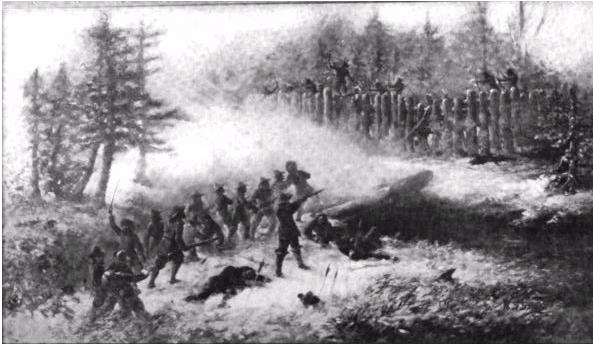
Massachusetts and Plymouth sent troops under the command of General Josiah Winslow. They would rendezvous with Connecticut’s forces at Jireh Bull’s garrison house on December 18. From there the combined army would attack the Narragansetts’ winter quarters in the Great Swamp. Rhode Island protested, but couldn’t prevent the Puritan army’s invasion.
 |
| Garrison house attack |
The army didn’t need Bull’s Garrison to fulfill their mission. They marched inland and destroyed the Narragansett fort and village. 150-300 Indians were killed and 450 captured at a cost of more than 200 Englishmen killed or wounded. The rest of the tribe dispersed, and many joined King Philip in his war.
On December 25, 1675, six days after the Great Swamp Fight, it was affirmed that every house in Narragansett was destroyed, and the all inhabitants entirely driven out. Richard Smith’s trading house at Wickford survived until the army left in January, 1676, then it, too went up in smoke. Providence suffered raids; men and homes were lost, but the town survived. Roger Williams was one of those who staid and went not away during the war, and was given part of money paid for Indian captives sold as servants.
 The population of Narragansett rebounded, but
Pettaquamscutt was no longer the center of activity. A few residents lived as
before, with their homes along the river and farms on inland fields. In the 18th
century the Narragansett Proprietors arose, making fortunes on land which had
belonged to the Indians, and raising livestock with slave labor. Stone walls
still mark the old properties and family cemeteries still survive, but nobody
remembers who lies in the oldest graves, and their field stone markers are
sinking below the sod and leaf litter.
 | |
| 1705 plat of Gardner home sites |
George Jr. was the first to receive a grant of Purchasers’ land on May 22, 1663, when John Porter wrote a deed indicating that George gardeners howse lott is Thirty rod wide and Eight scoore Rods long and at the lower end next mine. In November 1664 George and Benoni were granted land, but the location of Benoni’s house lot was not given. Their brothers Henry, William, and Nicholas also were granted land in 1670, 1671, and 1675 respectively, but there may have been grants which weren’t recorded.
In 1667 and ‘68 Herodias and Porter received a series of summons to court for that they are suspected to Cohabitt and Soe to live in way of incontinency. He was cleared on May 11, 1668, and she was finally found not guilty on October 21, 1668. They did marry, or at least Herodias was surnamed Porter instead of Long on subsequent deeds.
I believe that the house lot John Porter shared with Herodias Long lay between George and Benoni Gardner’s. John Watson owns it on the 1705 plat. Perhaps Herodias shared that lot with the Watsons after King Philip’s War, and it devolved to them after Herodias’ death. Herodias Long’s children began returning to Pettaquamscutt Pond by July 22, 1676, when Dorcas (Gardner) Watson’s son John was the first English child born in Narragansett after the war.
Interestingly, it seems that John Porter intended to give Herodias land back in November 1664, six months before she was separated from George Gardner. No deed was recorded for Horod Long – the name she apparently preferred – but her son’s deed was: Bounded as followeth: Sowth on Benony Gardners land, and Westerly on Sacgatoket River, and northwest going over the River bounded with a [slash] and the north East bounded with Mr. Arnold’s Land and that Line running East bounded with a great [Rocke] and the East side of the said Land Lying next Horrod Long’s Land. And wee whose names are above written for ourselves and the rest of our partners (viz) William Brenton, John Hull and Samuell Willson give up and surrender all our Rights to the foresaid land, having [Received] valuable Consideration …
John Porter disappears from the record after writing a deed on May 27, 1675, the eve of King Philip’s War. It is not known when or where he died. Robert Anderson estimates that Porter was born before 1608, but his English background before Porter married Margaret Odding ca. 1630 in Braintree, County Essex, is unknown. It’s not known when Porter died either. Was he evacuated to Portsmouth, and died there?
It appears that Herodias (Long) Hicks Gardner Porter died in 1705. On November 11th, 1705 Bennony & Mary Gardner, Henry & Joan Gardner, George & Tabitha Gardner, William & Elizabeth Gardner, Nicholas & Hannah Gardner, and John & Rebecca Watson sold 410 acres bounded by Pt. Judith Pond to John Potter for £140. The money was sent to Thomas Hicks of Flushing, Herod’s son fathered by John Hicks. I’m not the first researcher to conclude that this represents a bequest by Herodias Long, to a child taken from her over sixty years before her death.
Sources:
Rhode Island colonial records
Land records of North Kingstown and South Kingstown
The History of Washington and Kent Counties J.R. Cole
1889
The Great Migration Begins
Robert C. Anderson 1995
Flintlock and Tomahawk
Douglas Leach 1958
The Lands of Rhode Island Sidney Rider
1904