My historical novels Rebel Puritan and The Reputed Wife, Herodias (Long) Hicks Gardner Porter, colonial New England, travels, and whatever else seizes my fancy...
Showing posts with label John Winthrop. Show all posts

Sunday, June 29, 2014

Resurrecting Pettaquamscutt


Rebel Puritan

As I work on The Golden Shore, the final volume in my Rebel Puritan trilogy, my focus is shifting from Herodias (Long) Gardner’s home in Newport, Rhode Island to the western shore of Narragansett Bay. That was New England’s frontier in the 1650’s. The Narragansetts, Niantics, and Nipmucs still controlled western Rhode Island. Beyond them lay Mohegan and Abenaki territory. Still further off were the Mohawks, both respected and feared for their warlike nature.

The view from Pettaquamscutt Rock
Pettaquamscutt Rock was a notable landmark on the western side of Narragansett Bay for Native Americans. The name is loosely translated as ‘the round rock,’ and is well deserved. A bald knob of gray granite, studded with quartz and feldspar crystals, crowns a ridge which towers nearly 200’ above the Narrow River.

Narragansett country
That waterway was known as the Pettaquamscutt River in 1638, when William Coddington and Roger Williams met below the Rock with Canonicus and Miantonomi. The chief Narragansett sachems signed a deed giving Aquidneck Island to the Englishmen, in trade for forty-five fathoms of white wampum, twenty hoes, and ten coats. Considering that Aquidneck Island is now known as Rhode Island, and the finest mansions in Newport are found there, the English settlers got a bargain.


At that time, there were few Englishmen south of Richard Smith’s trading post in Cocumcussoc (now Wickford). Nearly all the land on the west side of Narragansett Bay, including Pettaquamscutt Rock, remained in Narragansett hands until January 20, 1657-8. On that date, the Pettaquamscutt Partners – John Porter, Samuel Wilson, Thomas Mumford, Samuel Wilbore (from Portsmouth, RI) and John Hull (of Boston, and the mint master of Massachusetts) – received a deed from Quassuchquansh, Kachanaquant, and Quequaquenuet, chief sachems of Narragansetts.

In exchange for £16 and “other considerations,” the partnership now owned all the land and the whole hill called Pettaquamscutt bounded on the south and southwest side of the rock with Ninigret’s land, on the east with a river northerly bounded two miles beyond the great rock in Pettaquamscutt westerly bounded by a running brook or river beyond the meadow, together with all manner of mines, etc., they to have free ingress and egress on the sachems’ lands.
  
Pettaquamscutt Purchase map
This was the initial Pettaquamscutt Purchase. Eventually, they owned 12 square miles, but on subsequent deeds they paid larger sums of money – £135, and on another deed, £13 15s. For 13 coats a pair of briches. At least they paid the Narragansett sachems for their land, unlike their neighbors in the Atherton Purchase.

 The Atherton Purchase – all of Boston Neck – was described as a ‘deed of gift.’ There were claims that Humphrey Atherton and John Winthrop Jr., governor of Connecticut, had taken Kachanaquant, one of the sachems in the 1658 deed, to Boston, and that they kept Kachanaquant drunk for three days until he agreed to grant Boston Neck to them. 

Back to the 1658 sale of the Pettaquamscutt Rock: what were the other considerations in that deed? It might be a promise, or work performed. It might be a present that the donor didn’t want recorded in a legal document. It was against the law to sell guns or liquor to the Narragansett Indians, but both were highly desired.

The sachem Kachanaquant signed all but one of the Purchaser’s deeds, and several deeds bore only his name. We can’t know exactly what Kachanaquant and the other sachems accepted in trade for their lands, but Roger Williams described Kachanaquant a poor beast (always drunk). The chief was called before Rhode Island authorities on numerous occasions to confirm that he hadn’t been plied with alcohol: Coganaquant came before me and owned his hand and seale to the deed of gift herein specified, and declares that he was not in drink, but sober at the affecting of it (John Sanford May 18, 1668). 

Whether that was true or not, land buyers flocked to Kachanaquant between 1658 and 1662, including the past and present governors, William Coddington and Benedict Arnold. In 1663 the Pettaquamscutt Purchasers began writing the first deeds for house lots and acreage to the first known landowners: Jireh Bull, William Bundy, William Haviland, and George Gardner Jr., who was only 14-15 years old.


A house was fortified to withstand attack was called a garrison house. A four-room, two story building, 84’ long and 20’ wide, and with its first story made of stone, was built by William Bundy on a ridge above the lower Pettaquamscutt River. It had a good view of traffic entering the river from the bay, and was also conveniently sited by the Pequot Trail. Travelers between Connecticut and Boston now had a place to trade or to rest for the night. Bundy moved to North Carolina in 1664 and sold his garrison house to Jireh Bull.


Lower Pettaquamscutt River
A settlement called – naturally – Pettaquamscutt sprang up on Tower Hill, and along the river flats below Jireh Bull’s trading post. They built ocean-going ships, and raised livestock traded throughout New England and to the Indies. On May 14th 1664 Richard Smith, a Connecticut sympathizer, complained that they had constituted officers at Petacomscott, and the Purchasers Thomas Mumford and Samuel Wilson, who now dwelt at Pettaquamscutt, served as constables.

By 1671 Pettaquamscutt was thriving. Rhode Island’s general court met there, and Mr. Jireh Bull, Mr. Samuell Wilson, Mr. John Porter, Thomas Mumford, John Tift, William Hefernan, Rouse Holmes, James Eldridge, Samuell Albro, Benoni, Henry, George & Nicholas Gardner, George Palmer, Stephen Northup, William Aires, George Crofts, Enoch Plaice, and Christopher Holmes did give their engagements for their allegiance to his majestie and fidelity to this colony. William Gardner owned land adjacent to his brothers, but was not at the meeting.


John Porter, also one of the Purchasers, dwelt on the shore of Pettaquamscutt Pond, a couple miles north of Bull’s garrison house. So did the woman who became his second known wife: Herodias Long. On March 20, 1664-5 the king’s commissioners held a court at Pettaquamscutt, and Herodias petitioned them for a final separation from George Gardner. Rhode Island knew George as Herodias’ second husband, but she now revealed that they had never married. After a stiff fine and a firm scolding, the colony granted Herodias her separation on June 5th.


Gardner home sites on Pettaquamscutt Pond
When Herodias Long brought her seven children fathered by George Gardner to live along Pettaquamscutt Pond, they became a village unto themselves. The family of Hannah (Hicks) Haviland, Herodias’s eldest child and the daughter of John Hicks, also lived nearby. William Haviland, was given a grant in Pettaquamscutt by the Purchasers in 1663, but the Havilands didn’t stay long. William sold their house on July 5, 1667 and the rest of his land on April 1, 1675, and they returned to Flushing, NY.

The five Gardner boys lived side by side with John Watson, their brother-in-law, who arrived by 1672. He married Dorcas Gardner, and his second wife, Rebecca, was probably the sister of Dorcas. John Porter granted the men home lots adjacent to his, made over deeds of Pettaquamscutt land to them, presumably in return for labor, and made them his heirs in the Pettaquamscutt Purchase.


Herodias Long’s extended clan prospered for a while, but the Narragansetts who once owned their land did not. Perhaps Kachanaquant didn’t understand the English concept of ownership when he sold that land to the Pettaquamscutt Purchasers. However, his ignorance – and the greed of English land buyers taking advantage of Kachanaquant’s naiveté – harmed the Narragansetts deeply. They were forced off broad swaths of prime hunting and farmland. Rhode Island put a stop to Indian land sales without the colony’s approval, but settlers had who bought that land from the now-protesting Narragansetts and Niantics were backed by Rhode Island’s government, and by King Charles II. The Narragansetts retreated to dry land around the Great Swamp. Discontent abounded, but Rhode Island kept the peace with the Narragansetts.

King Philip/Metacomet
However, in June, 1675 war broke out just to the east. In 1620 the Wampanoags had aided the Pilgrims of Plymouth. Now, they were even more severely squeezed than the Narragansetts. Raids and skirmishes escalated into Wampanoag raids on outlying villages, and King Philip’s War ensued, so-named for the Wampanoag chief. His name was Metacomet, but the Englishmen knew him as King Philip.

When fighting broke out only forty miles away, most of Pettaquamscutt was evacuated. On June 27, Roger Williams was at Richard Smith’s trading post in Wickford, RI. He wrote to Governor John Winthrop of CT, Mrs. Smith and most of the women and children left on the 26th, and just now Sam Dyer came from Newport to fetch Jireh Bull’s wife & children, and others of Pettaquamscutt.


Though the Narragansetts pledged their neutrality, Puritan leaders doubted their sincerity. To prevent the Narragansetts from bringing their 2000 warriors into the fight, the United Colonies dispatched an army to the Narragansetts’ winter home in Rhode Island’s Great Swamp. With luck, they would catch the Indians unaware.


Massachusetts and Plymouth sent troops under the command of General Josiah Winslow. They would rendezvous with Connecticut’s forces at Jireh Bull’s garrison house on December 18. From there the combined army would attack the Narragansetts’ winter quarters in the Great Swamp. Rhode Island protested, but couldn’t prevent the Puritan army’s invasion.


Garrison house attack
The Connecticut army found Bull’s Garrison burned and its defenders slain. James and Daniel Eldred are said to have survived the Indians’ attack on Bull’s Garrison, but fifteen unknown Englishmen, women and children were dead. A Narragansett envoy from the sachem Pessicus said that the garrison was destroyed in retaliation for an English raid near Providence four days before Jeri Bull’s house was burnt and those people killed there.  

The army didn’t need Bull’s Garrison to fulfill their mission. They marched inland and destroyed the Narragansett fort and village. 150-300 Indians were killed and 450 captured at a cost of more than 200 Englishmen killed or wounded. The rest of the tribe dispersed, and many joined King Philip in his war.

On December 25, 1675, six days after the Great Swamp Fight, it was affirmed that every house in Narragansett was destroyed, and the all inhabitants entirely driven out. Richard Smith’s trading house at Wickford survived until the army left in January, 1676, then it, too went up in smoke. Providence suffered raids; men and homes were lost, but the town survived. Roger Williams was one of those who staid and went not away during the war, and was given part of money paid for Indian captives sold as servants.

The population of Narragansett rebounded, but Pettaquamscutt was no longer the center of activity. A few residents lived as before, with their homes along the river and farms on inland fields. In the 18th century the Narragansett Proprietors arose, making fortunes on land which had belonged to the Indians, and raising livestock with slave labor. Stone walls still mark the old properties and family cemeteries still survive, but nobody remembers who lies in the oldest graves, and their field stone markers are sinking below the sod and leaf litter.

1705 plat of Gardner home sites
The Gardners and Watsons returned to build new homes along the western shore of Pettaquamscutt Pond. They inherited John Porter’s Pettaquamscutt lands, and their descendants grew wealthy along with the rest of the Narragansett Proprietors. My favorite piece of Gardner evidence is this fire-scarred plat drawn on October 5, 1705. From north to south the lots line up: Nicholas, William, Henry, John Watson (wed to Dorcas and Rebecca Gardner), George Jr., and a sixth lot divided into six strips. It’s possible that the sixth lot was retained as common grazing for the Gardner, Porter, and Watson livestock, since the house lots by the Pond are steep and rocky, but perhaps it was set aside for another person close to Herodias Long or John Porter – one who never came to Pettaquamscutt.
  
George Jr. was the first to receive a grant of Purchasers’ land on May 22, 1663, when John Porter wrote a deed indicating that George gardeners howse lott is Thirty rod wide and Eight scoore Rods long and at the lower end next mine. In November 1664 George and Benoni were granted land, but the location of Benoni’s house lot was not given. Their brothers Henry, William, and Nicholas also were granted land in 1670, 1671, and 1675 respectively, but there may have been grants which weren’t recorded.

In 1667 and ‘68 Herodias and Porter received a series of summons to court for that they are suspected to Cohabitt and Soe to live in way of incontinency. He was cleared on May 11, 1668, and she was finally found not guilty on October 21, 1668. They did marry, or at least Herodias was surnamed Porter instead of Long on subsequent deeds.


I believe that the house lot John Porter shared with Herodias Long lay between George and Benoni Gardner’s. John Watson owns it on the 1705 plat. Perhaps Herodias shared that lot with the Watsons after King Philip’s War, and it devolved to them after Herodias’ death. Herodias Long’s children began returning to Pettaquamscutt Pond by July 22, 1676, when Dorcas (Gardner) Watson’s son John was the first English child born in Narragansett after the war.
  
Interestingly, it seems that John Porter intended to give Herodias land back in November 1664, six months before she was separated from George Gardner. No deed was recorded for Horod Long – the name she apparently preferred – but her son’s deed was: Bounded as followeth: Sowth on Benony Gardners land, and Westerly on Sacgatoket River, and northwest going over the River bounded with a [slash] and the north East bounded with Mr. Arnold’s Land and that Line running East bounded with a great [Rocke] and the East side of the said Land Lying next Horrod Long’s Land. And wee whose names are above written for ourselves and the rest of our partners (viz) William Brenton, John Hull and Samuell Willson give up and surrender all our Rights to the foresaid land, having [Received] valuable Consideration …

John Porter disappears from the record after writing a deed on May 27, 1675, the eve of King Philip’s War. It is not known when or where he died. Robert Anderson estimates that Porter was born before 1608, but his English background before Porter married Margaret Odding ca. 1630 in Braintree, County Essex, is unknown. It’s not known when Porter died either. Was he evacuated to Portsmouth, and died there? 

It appears that Herodias (Long) Hicks Gardner Porter died in 1705. On November 11th, 1705 Bennony & Mary Gardner, Henry & Joan Gardner, George & Tabitha Gardner, William & Elizabeth Gardner, Nicholas & Hannah Gardner, and John & Rebecca Watson sold 410 acres bounded by Pt. Judith Pond to John Potter for £140. The money was sent to Thomas Hicks of Flushing, Herod’s son fathered by John Hicks. I’m not the first researcher to conclude that this represents a bequest by Herodias Long, to a child taken from her over sixty years before her death.


Sources:
Rhode Island colonial records
Land records of North Kingstown and South Kingstown
The History of Washington and Kent Counties   J.R. Cole  1889
The Great Migration Begins  Robert C. Anderson 1995
Flintlock and Tomahawk  Douglas Leach  1958
The Lands of Rhode Island  Sidney Rider  1904

Monday, November 4, 2013

Mary Dyer Illuminated


My guest today is Christy K. Robinson, author of the 2013 historical novel, Mary Dyer Illuminated, its forthcoming sequel Mary Dyer: For Such a Time as This, and the non-fiction The Dyers of London, Boston, and Newport.

I hold a great deal of enthusiasm for both Christy and her books about Mary Dyer, not only because they encompass the life and times of Herodias Long, but also because Mary Dyer Illuminated is a superb read, and Christy is a superb friend. And now, without further ado, here’s Christy!

Thank you, Jo Ann, for hosting this interview on your website. Your readers should know that through our research into Herodias Long and Mary Dyer, Jo Ann and I became acquainted in Facebook, and then close friends who shared research, after which personal details bonded us together. When Jo Ann took a road trip, we got to spend some hours together in my home. We’re even cousins, going back to late-17th century New Englanders.

JB: Your history is impeccable. When did you begin research for your book?
CR: I did a lot of genealogy research on my family lines when I was a teenager, driving my mom to the LDS genealogical library about 30 miles across the city. These were printed books and microfilms, long before the Internet came to town! She discovered that she and I were direct descendants of Mary Barrett Dyer, whom I’d never heard of. 

We both believed the stuff you read now on the Wiki and genealogy pages, which were copied from the Quaker historians: that Mary Dyer was hanged (the word is hanged, not hung) “for the crime of being a Quaker.” But as you’ll see in my research blog, two novels, nonfiction book, Facebook pages, etc., that is NOT the case. It wasn’t a crime to “be” a Quaker, and no one died for it. Mary and three men deliberately chose to die in civil disobedience, though they had several clear opportunities to just leave Massachusetts Bay Colony.

Mary Dyer's statue
I was commissioned to write and photograph a women-in-ministry convention in New England during leaf-peeping time in October 1997.  As we traveled by coach, a history professor lectured on the Quaker women who were persecuted in the area, and that Hutchinson and Dyer had memorial statues “on Boston Common.” (Actually, they face the Common.) When I learned I’d be stuck at Logan Airport for hours before my plane would board, I jumped into a taxi for a ride to the Common for a personal quest. I was not wearing proper shoes for city walking, cobblestones, or the half-run I made through the park, peering at every monument. Finally, I found Mary, and took several photos before taking another taxi back to the airport. I went home, consulted my files, and counted up the “greats” behind “grandmother”: nine greats. Twelve generations.

The philosophical and theological bits have been a lifelong interest, and while doing some hobby genealogy study on Mary Dyer in about 2006, I ran up against terms I didn’t understand. So I started reading about Anne Hutchinson and antinomian beliefs, and then early Quaker beliefs. It was a revelation to learn that my own church was rooted deeply in New England’s Puritan ways (not in doctrines, necessarily, but in the “corporate culture” of the believers). In 2010, I decided to write a novel about both Mary and William Dyer, and the research began with scores of books and hundreds of internet searches.

JB: How much is known of William Dyer and Mary Barrett’s early lives? Do you know where they were born?
CR: Very little is known of their early lives. There’s a christening record for William in September 1609 that lists his father’s name, but not his mother’s. Mary was born about 1610-11, probably in or near London. There are snippets of rumors that say she was in attendance at the court of Charles I, but no proof. The first real record of Mary is her wedding to William on September 27, 1633, at St. Martin-in-the-Fields church. 

JB: You write about Mary Dyer’s life as if you know her. How much is actually known of Mary’s early life?
CR: I think I do know her! But not because of any family stories, legends, or mystical experiences. As I explained above, what little I knew was wrong. But I so thoroughly researched her culture, religious beliefs, friends and enemies, surroundings, what took place later in her life, etc., that I could place her in situations and then project what probably happened based on what the people around her did and said.

As for what is actually known about Mary, I learned that many of the things I thought were established fact, were written by Quaker historians who had an agenda, which was not to write factual details or investigative journalism. Their agenda was to promote their beliefs and persuade others to support or at least tolerate their practices. In essence, they were public relations and communications managers for their new sect. I recognized that because it’s what I did for years, for two universities and a nonprofit organization!

JB: John and Margaret Dyer were real people. Why did you choose them for Mary’s guardians?
CR: I saw John’s name in a tax record on Johan Winsser’s trustworthy research website. John’s poor-roll tax was substantial, so they had some money. Then I went hunting for, and found, his childless wife that he married rather late in life. They lived in the right place and had a name that would fit my novel plotting.

1625 London plague woodcut
I also decided that with major plague epidemics regularly raging in London, and killing tens of thousands of residents at a time, Mary Barrett and William Dyer and his master must have had an escape hatch. And since Mary would be a mistress of garden and farm servants in just a few years, she would have to learn practical economics. So I needed people who lived out in the country but had ties in the city. I created the Stansbys, in the real village of Willesden.

JB: I remember being told in school that the Puritans came here for religious freedom. You write that they hid their religious intent behind stated plans to make investors rich.
CR: Yes, they were a corporation designed to make money in development and export of New England’s natural resources of timber, shipbuilding, furs, food production, fishing, and other commercial pursuits, plus all the support industries to make a viable, flourishing community. Really, who could blame them, when they had to sell their homes, farms, animals, and businesses in England that were being heavily taxed? They were imprisoned by the king’s men for their dissent and refusal to conform to religion or government. Some of them had to flee their homeland in secrecy to avoid imprisonment. So often, incarceration itself caused death.

Of course, religious freedom meant that they were free from Anglican rule, but they held themselves to a far more strict code. In London, John Winthrop worked as a magistrate in wills and estate trusts, but his refusal to take the usual bribes and deal dishonorably as his colleagues did made him stand out, and he had to resign and try to melt into his Essex manor until the fleet could depart from England. They seemed very moderate when they were in England, but when they got to Massachusetts, they were religious extremists. John Endecott, in particular, was a proto-Taliban! They truly intended to build a New Jerusalem that would hasten the second coming of Christ.

You might be surprised to learn that I wrote John Winthrop, a man who became a principal enemy of Hutchinson and Dyer, as a sympathetic character in his private life.  But I could never get into Endecott’s head or find a sympathetic trait. I had other characters describe him.

JB: The Puritans took the royal charter for Massachusetts with them. What does that signify?
CR: The charter should have been kept in London with every other official document. With the king’s seal on it, they acted as if in his name and authority. But they always intended to form their own theocratic government with minimal oversight from the king they considered pro-Catholic and politically repressive. King Charles demanded the return of the charter numerous times, but Winthrop ignored the orders. When an envoy tried to come over and take it back, his ship seemed to disintegrate under him like some X-Files scene. Winthrop gloried in that, saying that God had miraculously protected them.

JB:  We think of Puritans all dressed in black and white. However, your women wear rainbow colors.
CR: Black clothes were only for the very rich because they were expensive to dye and maintain without fading in the sun or the washing.  The few portraits from New England at that time were done of the elite members of society who were wearing their best duds at the sittings: black. I read lots of blogs on fashions, including Plimoth Plantation’s, and studied paintings of the 17th century, to see what men and women wore. Guess what: not that many ball gowns! I also chased down what Englishwomen wore to their weddings, and they were not wearing white until Queen Victoria, two centuries later.

"Blood Moon"
JB:  Was there really a lunar eclipse on the night of Anne Hutchinson’s miscarriage? New Englanders’ hair must have been standing on end at the sight of the blood moon.
CR: There really was a blood-red lunar eclipse on June 25, 1638, and it was observed on Aquidneck Island—by our people! The blood moon was, to them, a sign of the Apocalypse. But no one knows the date of Anne’s miscarriage. I timed out the reports of it in July, and I knew how long a molar pregnancy can last (about 12 weeks), and that there was no report of it on June 1, when the huge earthquake hit, so for dramatic purposes and Anne’s labor, I chose the lunar eclipse near the end of June—which would be 12 weeks after Anne was released from house arrest and had a celebratory conjugal reunion with her husband!

Christy K. Robinson
That’s one of the things that distinguishes my books from what’s come before and has been so heavily reliant on the Quaker writers. I used real events, internet research into science and medicine and astronomy, and a timeline!  The timeline opened my eyes to all kinds of surprises, and blew me away many times, as Jo Ann and my sister-in-law can attest. You’ll have to see the “signs and wonders” that begin in Mary Dyer Illuminated and come with even more importance in the second volume, Mary Dyer: For Such a Time as This (to be released in December 2013).  There’s also a Kindle-only companion book to the two novels, full of research into the culture and fascinating factoids I’ve found. That one is called The Dyers of London, Boston, & Newport.  

Thursday, October 31, 2013

Witches vs Winthrops


A witch with her familiars

Seventeenth-century folk believed strongly in divine forces beyond their understanding. Though we now understand earthquakes, lightning, hurricanes, and birth defects to be natural occurrences, those phenomena were thought to be created – and aimed at humans – by both God and Satan. Witchcraft was another force believed to be very real, especially by New England’s Puritans.

The first accusation of witchcraft in New England occurred in 1638, eight years after the settlement of Massachusetts. Several months before April 4, 1638, Mary Dyer of Boston bore a deformed child. The stillborn infant was secretly buried, but when word leaked out, it was exhumed. Governor John Winthrop recorded the investigation of this ‘supernatural’ birth in his journal [All of Winthrop’s accounts are edited here]:

Midwives
The wife of one William Dyer had been delivered of child some few months before, October 17, and the child buried, (being stillborn,) and viewed by none but Mrs. Hutchinson and the midwife, one Hawkins's wife … The midwife, after this discovery, went out of the jurisdiction; and indeed it was time for her to be gone, for it was known that she used to give young women oil of mandrakes and other stuff to cause conception; and she grew into great suspicion to be a witch, for it was credibly reported, that, when she gave any medicines, she would tell the patient if she did believe, [Hawkins] could help her.

This was the first suspicion of witchcraft recorded in New England. Jane Hawkins sensibly fled to Portsmouth, Rhode Island. If there was ever an accusation of witchcraft within Rhode Island, it was not given enough credence to enter the colonial record.  Rhode Island’s Puritan neighbors could not say the same.

MA governor John Winthrop
In summer 1640, Winthrop mused about a second woman skilled in midwifery. Anne Hutchinson once dwelt in Boston, but when she began interpreting Scripture to a large party of followers she was purged, along with any adherents who would not recant. Much of Anne’s party settled Portsmouth, Rhode Island. Puritans suspected that Anne Hutchinson used witchcraft to sway others to her beliefs, and Winthrop’s voiced his thoughts in his journal:

Mr. Collins, a young scholar full of zeal, and one Mr. Hales (a young man very well conceited of himself and censorious of others) went to Aquiday [Rhode Island], and so soon as Hales came acquainted with Mrs. Hutchinson, he became her disciple. These [influences], and others when [Hutchinson] dwelt in Boston, gave suspicion of witchcraft.
June 4, 1648: This time Winthrop, who still governed over Massachusetts, elaborated on a woman who was executed for witchcraft in his own colony: At this court one Margaret Jones of Charlestown was indicted and found guilty of witchcraft, and hanged for it. The evidence against her was:

 1. She was found to have such a malignant touch, as many men, women, and children whom she stroked or touched with any affection or displeasure were taken with deafness, or vomiting, or other violent pains or sickness.
 2. Her medicines being such things as were harmless, as aniseed, liquors, etc., yet had extraordinary violent effects.
3. She would tell such as would not make use of her medicine that they would never be healed, and accordingly their diseases and hurts continued, with relapse against the ordinary course, and beyond the apprehension of all physicians and surgeons.
 4. Some things which she foretold came to pass; other things she could tell of (as secret speeches, etc.) which she had no ordinary means to come to the knowledge of.
5. She had an apparent teat in her secret parts as fresh as if it had been newly sucked. After it had been seen upon a forced search it was withered, and another began on the opposite side.
6. In the prison there was seen in her arms, she sitting on the floor, and her clothes up, etc., a little child, which ran from her into another room, and the officer following it, it vanished. The like child was seen in two other places, and one maid that saw it fell sick and was cured by the said Margaret.

Her behavior at her trial was very intemperate, lying notoriously and railing upon the jury and witnesses, and in the like distemper she died. The same day and hour she was executed, there was a very great tempest at Connecticut, which blew down many trees, etc. 

Witch with familiar spirits
To 17th century Puritans, Margaret Jones exhibited classic signs of a witch: a familiar spirit by which she communicated with Satan, a witch’s teat created by suckling the devil (probably a skin tag resulting from childbirth), supernatural knowledge and skill in medicine, and the ability to sicken and kill merely by touching.

However, after the hanging of Margaret Jones, there were no more executions in Massachusetts during John Winthrop’s life. He was a keen observer of natural – and supernatural – phenomena, but apparently not a strong believer in witchcraft. He did not possess the persecuting zeal of Governor John Endecott, who sent four Quakers to the gallows between 1659 and 1661, including Mary Dyer of Newport, Rhode Island. Herodias (Long) Gardner of Newport was one of dozens who stood at the whipping post for preaching or defending Quaker beliefs. Neither did Winthrop have the credulity of Governor Simon Bradstreet, who oversaw the Salem witchcraft hangings in 1692.

John Winthrop died in 1649. He apparently came to regret his earlier persecution of Anne Hutchinson and her followers, Anabaptists, and other free thinkers. It was reported that Winthrop was asked to sign an order of banishment while on his deathbed. He refused, saying, “I have done too much of that work already.”

CT governor John Winthrop
In 1650, his son John Winthrop removed to the fledgling town of New London, Connecticut. In 1651 he became a magistrate in the Connecticut government, and on May 21, 1657 John Winthrop, Junior no longer because his father was dead, was elected Governor of Connecticut.
Before the notorious 1692 outbreak in Salem, Massachusetts, Connecticut was the hotbed of New England’s witchcraft. Not every convicted person on this list was executed, but those known or strongly suspected of having died are in red:


Young, Alice
1647
Hanged
Johnson, Mary
1648
Hanged
Bassett, Mrs.
1651
Hanged
Carrington, Joan
1651
Hanged
Carrington, John
1651
Hanged
Goodman, Elizabeth
1653, 1655
Convicted
Knapp, Goodwife
1654
Hanged
Gilbert, Lydia
1654
Hanged
Mary Staples
1654
Accused
Bailey, Mrs. Nicholas
1655
Convicted
Bailey, Nicholas
1655
Convicted
Meaker, William
1657
Convicted
Palmer, Katherine
1660, 1672
Accused
Jennings, Nicholas
1661
Tried, found not guilty
Jennings, Margaret
1661
Tried, found not guilty
Ayers, William
1662
Accused, fled
Ayers, Goodwife
1662
Accused, fled
Greensmith, Nathaniel
Greensmith, Rebecca
1662-3
1662-3
Hanged
Hanged
Barnes, Mary
Mary Sanford
1662-3
1662-3
Hanged
Hanged
Wakeley, James
Sanford, Andrew
1662-3, 1665
1662-3
Accused, fled
Tried, found not guilty
Seager, Elizabeth
1662-3, 1665
Convicted
Grant, Mrs. Peter
1662-3
Accused
Varleth, Judith
1662-2
Tried, found not guilty
Blackleach, John
1662-3
Accused
Blackleach, Elizabeth
1662-3
Accused

Connecticut’s Puritan magistrates and ministers fervently prosecuted alleged witches, and seven women were executed for witchcraft before 1657. In May of that year, John Winthrop became Connecticut’s governor. He was elected again in 1659, and remained governor until his death in 1676. Notice that in the list of witches, there were no hangings between Winthrop’s election and 1662.

However, from mid-1662 through much of 1663 there was a major witchcraft outbreak which resulted in four executions. It began when eight year-old Elizabeth Kelly died after several days of severe stomach pain. An autopsy determined that the girl died of ‘preternatural causes,’ and before her death, Betty Kelly repeatedly accused Goodwife Ayres of witching her to death. 

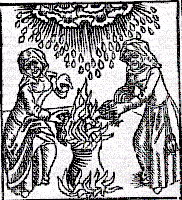
Witches' cauldron
The evidence against Goody Ayres is scant – she ate broth from a boiling kettle and shared it with Betty. When the girl fell ill many hours later, her parents no doubt questioned her closely about who was tormenting her. Betty told them that Goody Ayres was kneeling on her belly and pinching her. After Betty’s death, the blood pooled in her arms looked like bruises – evidence that Goody Ayres’ specter had indeed pinched Betty.

Soon another ‘possessed’ girl, Ann Cole, cried out on Elizabeth Seager, Goodwife Ayres, Rebecca and Nathaniel Greensmith, Mary Sanford, and others. William Ayres and his wife saved their lives by fleeing to Rhode Island. The Greensmiths, Mary Sanford, and Mary Barnes stayed in Hartford, were tried and convicted, then executed. Accused witches pointed fingers at their neighbors, and a score of people awaited their fates in jail. It seemed that there would be no end to the trials and executions.

Alchemist - Teniers
Walter Woodward, Connecticut state historian, notes that Governor John Winthrop Jr. “drew on his own fascination with alchemy and magic to save, rather than condemn, the accused.” Winthrop was a physician and an alchemist. Alchemy is the study of chemistry and minerals, with an eye to magically transform base metals to another element – gold. Some alchemists were accused of witchcraft, but Winthrop was fascinated by the notion. He was no magician or witch, and he used that knowledge to block trials and overturn convictions.

So, what happened to Governor Winthrop’s benign influence during the 1662 outbreak? John Winthrop had gone to England in 1661 in search of a royal charter for Connecticut. Though he was elected in absentia, Winthrop did not return until 1663, after four people had already been executed. After Winthrop’s return, the remaining trials were quickly concluded and convictions dismissed.

The 1662 Hartford witchcraft outbreak is of particular interest to me because Herodias (Long) Gardner, my favorite obsession, has a Connecticut witch connection. Herod’s son George was called to court in October, 1662 to answer for reproaching Rhode Island’s Governor Benedict Arnold a few months earlier. George was only fourteen, and was found not guilty, no doubt after apologizing for his rash words.

John Smith was not so lucky. For the same offense, the Rhode Islander had to pay a bond of £20 to ensure his future good behavior, and to nail up an apology on the jail house door. At Smith’s trial, it was revealed that he’d accused governor Arnold of issuing a “warrant to apprehend the wife of William Ayres who was sent after from Conneticott for breaking prison, & that having given out his warrant did send private notice to sayd Smith’s house that the woman might be convayed away so to escape the said warrant.”  I surmise that Governor Arnold did not believe in witchcraft either. While he was duty-bound to arrest a jail-breaker, it appears he warned the Ayreses so they could escape a spurious, and potentially lethal accusation.
Trial by Water
Goodwife Ayres (whose first name I cannot learn) is the same unfortunate woman accused of witching Betty Kelly to death in 1662. The Ayres couple may also have been subjected to the ‘swimming test.’ A letter written by Rev. John Whiting of Hartford to Rev. Cotton Mather of Boston, tells us that, “some had a mind to try whether the stories of witches not being able to sink under water, were true; accordingly a man and woman [accused by Ann Cole] had their hands and feet tied, and so were cast into the water, and they both swam after the manner of a buoy.’  Fortunately, that feeble evidence was not deemed legal means to convict the unhappy couple. 

However, Goody Ayres was jailed for trial in Betty Kelly’s death. A neighbor said he saw her dancing around a steaming cauldron with other witches. Another testified that Goody Ayres told her she had been courted by Satan in London. 

It looked grim for Goodwife Ayres until her husband William helped her escape from Hartford’s jail. The unhappy couple fled to Rhode Island, and with the help of Herodias Gardner and her family, disappeared from New England. I am featuring this incident in The Golden Shore, the sequel I am currently writing to Rebel Puritan and The Reputed Wife, my historical novels about Herodias Long.


Sources:
Witch-Hunting in Seventeenth-Century New England  David D. Hall  1991
The Witchcraft Delusion in Colonial Connecticut  John M. Taylor  1908

Related Posts Plugin for WordPress, Blogger...