|
| Vagabond Quakers |
Most Americans don’t like to contemplate their own history,
not even in fiction. Tudor or Plantagenet tales are usually the best-sellers. American
historical fiction tends to be about the Revolutionary or Civil War, or more
recent times readers can easily relate to.
What about 17th century New England, when the first colonies
were carved from raw wilderness? The region’s history is ripe with conflict and
compromise between Puritan and non-Puritan colonies, a pair of Indian
genocides, and the tragic heroism of Quakers using civil disobedience to combat
Puritan intolerance. Fertile plotlines begging to be developed, right?
The classic novels, Nathaniel Hawthorne’s The Scarlet Letter and Anya Seton’s The Winthrop Woman stem from those years,
but apart from witchcraft stories, there aren’t many like them (until recently).
What’s a reader hungry for fiction about early America to do?
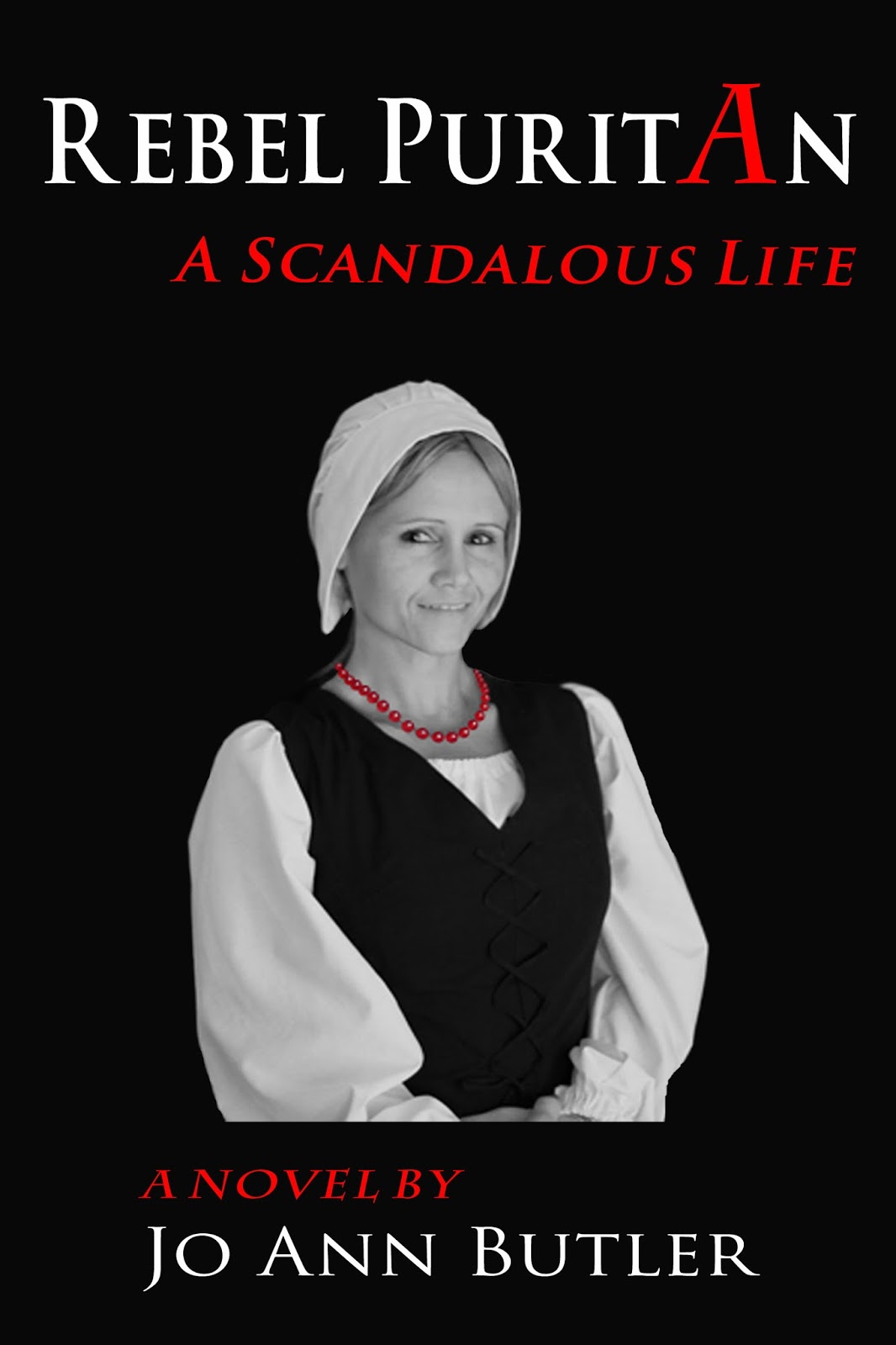 I decided to write my own. In 2011, I published Rebel Puritan, outlining the struggle
between conservative Puritans and Anne Hutchinson’s liberal outcasts who settled
in Rhode Island, as witnessed by my most notorious ancestor, Herodias Long.
Poor Herodias had her own struggle, discovering that it is far easier to marry
an abusive man in a patriarchal society than it is to be separated from him.
I decided to write my own. In 2011, I published Rebel Puritan, outlining the struggle
between conservative Puritans and Anne Hutchinson’s liberal outcasts who settled
in Rhode Island, as witnessed by my most notorious ancestor, Herodias Long.
Poor Herodias had her own struggle, discovering that it is far easier to marry
an abusive man in a patriarchal society than it is to be separated from him.
I continued with The
Reputed Wife in 2013, delving into Puritan colonies’ horrific anti-Quaker
laws, and the determined Quakers who challenged them. Herodias was one of
dozens whipped and jailed for speaking out against the brutal sentences, but
her friend Mary Dyer was one of four Quakers hanged for defying orders of
banishment. The executions and brutal whippings, especially of women, caught
the eye of King Charles II, who ordered the hangings to cease. More
importantly, Charles upheld Rhode Island’s freedom of religion, which is now
enshrined in the United States Constitution.

In 2017 I completed Herodias’ saga in The Golden Shore, in which Rhode Island unites its own restless
factions, while Herodias must decide how much independence she is willing to
sacrifice for love. I am now working on Rebel
Seed, exploring Joshua Tefft’s execution for treason during King Philip’s
War, the last-ditch effort of New England’s Indian tribes to regain land they
had lost to English settlers’ encroachment.
Best of all, since Rebel
Puritan came out, other authors have used fiction to explore the
Quaker-Puritan conflict! Christy K. Robinson’s sensitive and penetrating
treatment of Mary Dyer’s life and martyrdom in Mary Dyer Illuminated and For
Such a Time as This are must-reads in colonial fiction.
 |
| The Whip and Cart Act |
In 2017, Olga Morrill’s riveting Vagabond Quakers took up shortly after my Reputed Wife and Christy Robinson’s Mary Dyer series ended at the
gallows. Hanging Quakers was forbidden, so New England’s Puritans revive an old
English barbarity in its place – the Whip and Cart Act.
The law calls for Quakers who refuse to stay out of
Massachusetts to be tied to the tail of a cart, stripped to the waist, and
whipped out of the colony – given 10 lashes in three towns as they walk, or are
dragged, to the wilderness beyond Massachusetts’ border.
In 1662 Mary Tomkins and Alice Ambrose, English Quaker
missionaries, arrive in Dover (Massachusetts’ northernmost town). They are
banished, and yet they return. In court, they meet an ambitious, steel-willed
magistrate, Richard Walderne, who is determined to make an example of them.
Along with the fragile Anne Coleman, the three missionaries are sentenced to be
lashed not just in three towns, but in every town between Dover and Dedham – 11
towns spread over 80 miles. If the women can survive 110 stripes from a
three-lashed whip, being dragged through December snows when they can no longer
walk will surely prove fatal.
A sympathetic official discharges them after ‘only’ two
whippings, but Mary and Alice return to Dover as soon as they can travel. Now,
Walderne and his cronies are bent on ensuring that this defiance will be their
last act.
I just love this story! Ms. Morrill has long experience as a storyteller
and columnist, her smooth prose paints a vivid picture with the best of ‘em,
and her research is impeccable.
Readers need to pay heed to the chapter headings, for Vagabond Quakers traces both Richard
Walderne’s, and Mary and Alice’s lives. Her scenes switch in time as much as 25
years, but lead inexorably to the fateful meeting of these strong-willed foes.
Vagabond Quakers ends
with its characters in in flux, but this is the first volume in The Vagabond Trilogy. Ms. Morrill is
taking a long view, and her next work will shift the scene to Rhode Island, where
my own works take place. I look very much forward to what comes next.